



Most people who’ve tried magic mushrooms have done so at 1 gram, maybe 2. A comfortable, curious, manageable experience. Colors shift a little. Music sounds better. You feel connected and warm.
Five grams is something else entirely.
“At 5 grams, the world as you know it ceases to exist.”
That’s not an exaggeration. It’s not hype. It’s the honest, reported reality of what happens when a human being consumes what ethnobotanist Terence McKenna famously called a heroic dose — five dried grams of Psilocybe cubensis, taken intentionally and with full commitment.
This post is not a guide on whether you should do it. It’s a detailed, honest, minute-by-minute breakdown of what the heroic dose actually feels like, why it feels that way, and what the science says is happening in your brain while it unfolds.
Read it whether you’re curious, preparing, or simply trying to understand what people mean when they say a mushroom experience changed their life.
Before We Start: What Is the Heroic Dose?
Terence McKenna — the American ethnobotanist, philosopher, and one of the most influential voices in psychedelic culture — coined the term “heroic dose” to describe a very specific method of consumption: five dried grams of Psilocybe cubensis, taken alone, on an empty stomach, in silent darkness, with eyes closed.
McKenna’s framework was intentional. The darkness and silence eliminate external anchors for the mind. The solitude strips away social performance. The empty stomach accelerates onset and maximizes absorption. Together, these conditions create the optimal environment for what McKenna described as a “profound visionary experience.”
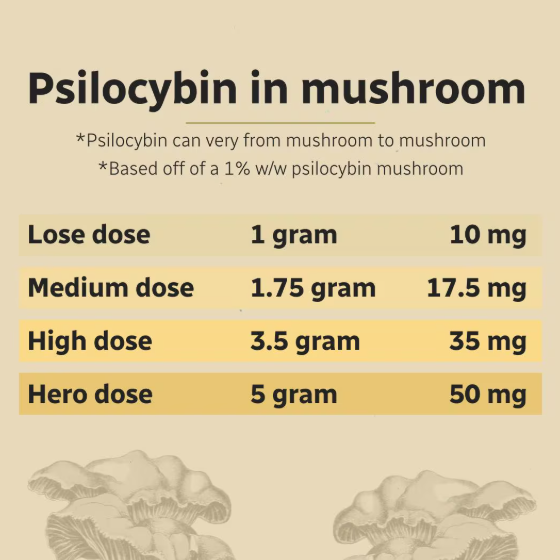
DoubleBlind Magazine describes it plainly: unlike high doses, which hover around 3.5 grams or so, heroic doses are strong enough to take you out of your present reality entirely.
The name itself is worth unpacking. “Heroic” doesn’t mean brave in the ordinary sense. It refers to the Hero’s Journey — the archetypal process of personal transformation described in myths and fairy tales across human history. You go in. You are changed. You return different.
Important disclaimer: This blog is for educational and harm reduction purposes. A heroic dose is not a recreational experience. It carries real psychological risks and is not appropriate for everyone. Never attempt a heroic dose without prior lower-dose experience, a safe set and setting, and ideally a trusted sitter or guide present. Read our full Magic Mushroom Safety Guide before proceeding.
What 5 Grams Actually Contains
Before the timeline, a quick pharmacological note: when you eat 5 grams of dried P. cubensis, you’re consuming approximately 30–50 mg of psilocybin — based on average psilocybin content of around 0.5–1% of dry mushroom weight, with a range across species of 0.03% to 1.78%. In Johns Hopkins clinical research, the highest doses studied were 30 mg/70 kg bodyweight — roughly equivalent to 3–5 grams of dried mushrooms. So 5 grams sits at the very top of what clinical researchers consider the high-dose threshold.
At those doses, Johns Hopkins research found that 72% of volunteers had mystical-type experiences, and one month later they rated the session as having substantial personal and spiritual significance, with sustained positive changes in attitudes, mood, and behavior that were still undiminished at 14-month follow-up.
That context matters. The heroic dose isn’t folklore. It’s one of the most rigorously documented psychological experiences in modern science.
For a deeper look at how strain potency affects this equation, check out our complete mushroom strains guide. A Penis Envy 5-gram experience is categorically different from a 5-gram Golden Teacher experience.
The Minute-by-Minute Timeline
What follows is a composite account drawn from community reports, clinical research timelines, and pharmacokinetic data. Every person’s experience differs based on body weight, metabolism, strain potency, stomach contents, emotional state, and environment. But the broad arc — the phases, the transitions, the quality of experience — is remarkably consistent at this dose level.
The clock starts when you swallow.
⏱ Minutes 0–20: Stillness Before the Storm
You’ve eaten. The mushrooms are in your stomach. For the first 15–20 minutes, there’s often nothing detectable happening — just you, your breath, and the quiet awareness that something irreversible has been set in motion.
Most people describe a rising anticipatory tension during this window. Not quite anxiety, not quite excitement — something between the two. Your body knows. Your mind doesn’t yet.
Some people feel mild stomach awareness — a slight gurgling or warmth in the gut as the psilocybin begins its conversion to psilocin in the liver. This is normal, and at this dose, it’s almost a reliable signal that the process has begun. If you’re sensitive to nausea, having consumed your mushrooms in tea or chocolate form will have dramatically reduced this. For a full breakdown of how format affects onset, read our post on mushroom chocolate and bioavailability.
What to do: Lie down. Close your eyes. Set your intention one final time. Breathe slowly. You will not be able to stop what comes next — only receive it.
⏱ Minutes 20–40: First Contact
The first signals arrive. They’re subtle at first — easily mistaken for imagination — and then unmistakably real within minutes of each other.
Visual field shifts. With eyes closed, the darkness behind your eyelids begins to develop texture. Geometric patterns emerge — symmetrical, complex, pulsing faintly at first. Colors that aren’t there begin to accumulate in your peripheral vision. With eyes open, objects begin to breathe. The ceiling undulates. Edges soften.
Body sensations begin. A warmth or electricity moves through your limbs. Some people experience a wave of nausea at this point — especially on dried mushrooms consumed raw — which passes within 10–15 minutes for most. Some people feel a strong urge to yawn or stretch as the body responds to the sudden neurochemical flood.
Time starts to distort. The gap between thoughts stretches. What feels like 20 minutes may have been 5. The ordinary rhythm of your internal clock begins to slip.
At the pharmacological level, psilocin is now binding rapidly to 5-HT2A serotonin receptors concentrated in the prefrontal cortex. Blood levels of psilocin are rising quickly. The brain is beginning to experience what researchers describe as “massively disrupted functional connectivity” — the normal routing of neural signals is breaking down and new, unexpected connections are forming.
The feeling: An elevator beginning to rise. Still inside the building. But moving.
⏱ Minutes 40–60: Liftoff
This is where 5 grams separates itself from every lower dose you’ve ever tried.
The visual field doesn’t just shift — it transforms. With eyes closed, you are no longer in darkness. You’re inside an architectural space of cascading geometric forms: mandalas within mandalas, fractal landscapes that breathe and morph with impossible detail. Colors no longer correspond to anything in the physical world — you’re witnessing hues your waking consciousness has no name for.
Synesthesia begins. Music (if you’re listening to any) becomes visible. Sounds have textures. The boundary between senses starts to dissolve. A high dose brings “kaleidoscope visuals when eyes are closed or open, sensory and perceptual changes, synesthesia like hearing colors or tasting sounds, cognitive changes, and ego dissolution.”
Emotional intensity spikes. Whatever emotional material exists in your psyche — unprocessed grief, old fear, deep love, awe — begins surfacing rapidly and powerfully. This is not random. Psilocin’s action on 5-HT2A receptors disrupts the Default Mode Network (DMN) — the brain’s self-referential processing hub — creating a state in which emotional material bypasses the usual filters of ego-defense and moves directly into awareness. Neuroimaging studies have consistently shown that psychedelics like psilocybin significantly reduce DMN connectivity, and that this correlates directly with the subjective experience of ego dissolution.
Nausea (if present) typically ends here. The transition to peak is often the most physiologically turbulent part of the experience, but as the compound reaches full activity, most GI discomfort passes.
The feeling: You are no longer in the elevator. You’ve cleared the building. You’re above the clouds and still accelerating.
⏱ Hours 1–2: Entering the Deep
Language begins to struggle here. Not because the experience becomes incoherent — but because what is happening falls outside the categories that language was designed to describe.
Reality becomes fluid. The ordinary consensus structure of the world — the agreement that objects are solid, that self and other are separate, that time flows in one direction — loosens its grip entirely. At 5 grams, this is not a partial or metaphorical dissolution. It is literal. You may not know your name. You may not remember that you took mushrooms. You may not have a stable sense of being a person who is having an experience.
Ego dissolution begins. This is the defining feature of the heroic dose and the most difficult to describe to anyone who hasn’t experienced it. The “self” — the internal narrator, the sense of being a distinct person separate from the world — begins to quiet and then disappear. This is not a loss of consciousness. You are fully awake. But the one who is usually awake — “you” — is no longer present in the usual way.
What remains is awareness without a center. Experience without an experiencer. “In a state of ego dissolution, the boundaries are let down and a great zooming out takes place where you begin to see things on a macroscopic level. You are no longer an individual isolated from life as it takes place around you, but rather you are interconnected with everything through the web of life.”
From a neuroscience perspective, ego dissolution happens when the default mode network loses its usual grip and the communication between its hubs weakens. The DMN — which governs self-awareness, internal narrative, and the distinction between self and other — is dramatically suppressed by psilocin. What remains is pure, undifferentiated awareness.
Visions intensify to their maximum depth. At this point, with eyes closed, the visual content moves beyond geometry into full visionary experience. Landscapes. Faces. Beings. Symbolic narratives. Many people at this dose level describe encountering presences or entities — not experienced as hallucinations, but as encounters with something genuinely outside themselves. Whether this is neurological, philosophical, or spiritual is a question that science has not answered. What is documented is that it is experienced as profoundly real.
Time becomes irrelevant. The heroic dose produces its effects for 6 to 8 hours — but as time dilates during a trip of this kind, one’s perception of the time frame becomes far beyond that of ordinary measured time. What feels like lifetimes may be minutes. Many people report that subjective time during peak ego dissolution feels essentially infinite — not long, but dimensionless.
The feeling: You are not in a place. You are not a person. There is only this.
⏱ Hours 2–4: The Peak — Where the Work Happens
A heroic dose has three phases: the blast off, which usually happens within the first two hours; the strongest or peak experience, which occurs from around hours 2 to 4; and the comedown.
For many people, this is the most significant period of their lives. Not most significant drug experience. Most significant experience.
What commonly occurs at peak:
- Complete mystical experience — a sense of profound unity with all things, transcendence of time and space, overwhelming positive mood, and an encounter with something felt as sacred or ultimate. Johns Hopkins research using the Mystical Experience Questionnaire found that at high doses, 72% of participants reported mystical-type experiences, and these were rated among the five most meaningful and spiritually significant events of their lives — more meaningful than the birth of a child or the death of a parent.
- Emotional catharsis — grief, love, fear, joy, and awe flowing without the usual dams of ego-defense. People cry. People laugh. People face things they’ve been running from for years. The psychedelic process does not let you choose what surfaces.
- Challenging experiences — it’s critical to acknowledge that at this dose, difficult experiences are common and expected. Johns Hopkins data shows that at high doses, 39% of volunteers experienced extreme anxiety or fear at some point during the session. This is not a failure of the experience — it is often the most therapeutically significant part of it. The ability to move through difficulty, to practice surrender rather than resistance, is exactly what the heroic dose asks of you.
- Profound insight — about your life, your relationships, your patterns, your deepest fears and desires. These insights often feel more real and certain than anything you’ve understood before. Many persist long after the compound has cleared.
The neuroscience of the peak: Your brain is in a state that has no everyday analogue. Psilocybin has massively disrupted functional connectivity across cortex and subcortex — with research published in Nature showing this disruption is more than threefold greater than that of stimulant drugs. The brain’s usual specialized networks have dissolved into a state of massive global communication — sometimes called the “entropic brain” — in which every region is talking to every other region simultaneously. This is what produces the sense of universal connection, the dissolution of boundaries, and the perception that everything is deeply, meaningfully interrelated.
The feeling: Impossible to describe. People use words like birth, death, God, everything, nothing, home, ancient, infinite. Whatever it is, it is felt — with total certainty — as more real than ordinary reality.
⏱ Hours 4–5: The Tide Begins to Turn
Slowly — and it is slow — the peak begins to soften.
The return of self happens in fragments. A thought arrives that sounds distinctly like you. Then another. The geometric architecture of the closed-eye visual field begins to simplify. The undulations in the physical environment slow and soften. You begin to remember that you took mushrooms. You begin to remember your name.
This is often one of the most emotionally resonant phases of the entire experience — the return. There is frequently a profound sense of gratitude, of having been somewhere enormous and been returned to the ordinary world with something new. Many people cry during re-entry. Not from sadness — from the sheer intensity of the contrast between where they’ve been and the ordinary miracle of simply being alive.
Physical sensations return to the foreground. You may feel genuinely exhausted — the body has been running at neurological full capacity for hours. Mild jaw tension, a sense of physical weight, and deep fatigue are common. Drink water. Stay warm. Don’t rush to move.
The feeling: A ship returning to harbor after an enormous voyage. The sea is still moving. You can feel the difference in your body.
⏱ Hours 5–8: Resolution and Afterglow
The fully psychedelic phase is over. But the experience is not.
What remains is what the psychedelic community calls the afterglow — a period of unusual clarity, emotional softness, and perceptual richness that can last anywhere from a few hours to the following day. Music sounds beautiful. Food tastes vivid. Conversations feel meaningful in ways that ordinary conversation doesn’t.
Cognitive processing is active. Your mind is quietly beginning to organize and integrate what just happened. Insights surface in gentle, conversational form rather than overwhelming waves. This is an excellent time to begin journaling — even rough, half-formed notes — because the vividness of the experience fades faster than most people expect.
Emotional sensitivity remains elevated. Some people feel euphoric. Some feel fragile and tender. Some feel profoundly peaceful. All of these are valid and expected. Avoid stimulating environments, bright screens, or demanding social interactions during this window. Your nervous system has been through something significant and deserves care.
The feeling: Standing outside after a thunderstorm. Everything is quiet. The air is different. So are you.
What Happens in Your Brain: The Neuroscience Summary
For those who want to understand the biology underneath the experience:
The Default Mode Network Goes Offline
The DMN is the brain network responsible for self-referential thought — your internal narrative, your sense of being a distinct self, your rumination, your autobiographical memory. Psychedelics dramatically reduce DMN connectivity, and this reduction correlates directly with ego dissolution. When the DMN loses its grip, the sense of a bounded, separate self disappears — which is experienced as unity, oneness, or the dissolution of the ego.
Researchers at Imperial College London found that this “resetting” of the DMN is likely linked to psilocybin’s antidepressant effects — turning off the rigid self-referential loops associated with depression and reconsolidating them in a more flexible, less rigid form.
Global Brain Connectivity Explodes
Normally, different brain networks operate in isolation — the visual network, the auditory network, the emotional network, and so on. Psilocybin breaks down this segregation, creating vast cross-linking between networks that don’t normally communicate. This increased global connectivity is what produces synesthesia (hearing colors, seeing sounds), the sense that everything is connected, and the perception of visionary content with no external stimulus.
New Neural Connections Begin Forming
As we covered in our blog on Psilocybin and Neuroplasticity, a landmark 2021 Yale study showed that a single psilocybin dose produces approximately a 10% increase in dendritic spine density in the prefrontal cortex — new physical connections between neurons — within 24 hours, that persist for at least a month. The neural activity during your experience shapes which connections are built. What you think, feel, and process during the trip becomes, quite literally, new brain architecture.
This is why integration matters so much after a heroic dose. You’re not just processing an experience emotionally — you’re tending to new neural construction.
The Aftermath: What Changes
People don’t take heroic doses for entertainment. They take them because something needs to shift — and the evidence suggests it does.
Johns Hopkins research has documented that a single high-dose psilocybin session, combined with preparation and integration, produces:
- Significant reductions in depression and anxiety persisting for 6–12 months
- Increased psychological openness and flexibility
- Lasting changes in attitudes toward life, self, and others
- Reduced fear of death in patients with life-threatening illness
- More than 85% of participants rating the experience as one of the five most meaningful and spiritually significant of their lives
These are not small effects. These are among the largest and most sustained psychological outcomes ever measured in a clinical trial.
The heroic dose is not magic. It is not a guaranteed cure for anything. But at its best — properly prepared, properly supported, properly integrated — it is one of the most powerful tools available to the human mind for breaking patterns, dissolving defenses, and encountering the deeper layers of who you are.
Before You Consider It: The Essential Checklist
✅ Prerequisites
- Extensive experience at lower doses (1g → 2g → 3.5g minimum, over multiple sessions)
- No personal or family history of psychosis, schizophrenia, or bipolar disorder
- Not currently on SSRIs, MAOIs, or lithium
- A trusted sitter present or immediately reachable
- A safe, private, comfortable physical environment
- Clear intention set in advance
- An empty or near-empty stomach (3–4 hours fasted minimum)
- An integration plan for the days and weeks following
✅ Strain Matters
Do not attempt a heroic dose with a high-potency strain like Penis Envy unless you are deeply experienced. Experienced users recommend starting a 5-gram heroic dose with a moderate-potency strain like Golden Teacher or a similar cultivar. Check our full strain effects guide before selecting.
✅ Integration Is Non-Negotiable
The weeks following a heroic dose are a critical neurological window — new dendritic spines are maturing, new neural pathways are consolidating. Journal. Sleep. Move your body. Speak with a therapist or integration coach if possible. Don’t rush back to ordinary routine. For everything you need to know, read our Psilocybin Integration Guide.
Frequently Asked Questions
Is 5 grams the same for everyone?
No. Mushroom potency varies enormously by strain and batch. A 5-gram heroic dose of Golden Teacher is a very different experience from 5 grams of Penis Envy — which could be 2–3x more potent. Always know your strain, and always work up gradually. A dose that is “heroic” for one person may be moderate for another.
Will I lose control of my body?
At a true heroic dose, most people are lying still with eyes closed. Gross motor function remains intact — you can move, stand, and seek help if needed. However, your capacity for coordinated, purposeful action is significantly impaired for several hours. This is one of the most important reasons for having a sitter present.
What if it goes badly?
Difficult experiences at this dose are common and often the most therapeutically meaningful. The primary harm-reduction tool is surrender — resisting a difficult experience amplifies it, while accepting and moving toward it tends to move it through. Having a trusted, sober sitter who understands psychedelics and can provide calm, grounding presence is the single most important safety factor at this dose level.
How long until I should do it again?
McKenna himself advocated for infrequent use. He recommended no more than two to three times per year at this dose level. The neuroplasticity research supports this — new connections need weeks to mature and stabilize before the process is repeated. The standard community recommendation is a minimum of 30 days between high-dose sessions, and many experienced users wait much longer.
Is this the same as what happens in clinical trials?
Clinical trial doses typically range from 20–30 mg of pharmaceutical-grade psilocybin, which roughly corresponds to 2.5–5 grams of dried cubensis. The experiences described in clinical research — mystical states, ego dissolution, profound emotional processing — are qualitatively consistent with what community users report at the heroic dose. The key difference is the presence of professional therapists, a clinically optimized environment, and formal integration support. The experience itself is the same.
The Bottom Line
Five grams of dried magic mushrooms is not a party. It’s not a night out. It’s not a way to get high.
It is — if approached correctly — one of the most profound experiences available to the human mind. A full dissolution of the ordinary sense of self. A direct encounter with something that most people describe as larger than any category their usual consciousness contains. And, consistently, an experience that is rated months and years later as among the most meaningful of an entire lifetime.
The timeline above is a map. But maps are not the territory. No description — not this one, not any — can prepare you for what 5 grams actually feels like. The preparation, the intention, the surrender, the integration: those are the real work. The compound just opens the door.
Happy tripping. Tread wisely.
Ready to explore at your own pace? Browse our full selection of magic mushrooms, read our Microdosing 101 Guide if you’re starting smaller, or check out our complete strain guide to find the right mushroom for your journey.
Sources
- Wikipedia — Terence McKenna — https://en.wikipedia.org/wiki/Terence_McKenna
- Wikipedia — Psilocybin Mushroom Dosing — https://en.wikipedia.org/wiki/Psilocybin_mushroom
- Griffiths et al. (2011) — “Psilocybin occasioned mystical-type experiences: Immediate and persisting dose-related effects” — Psychopharmacology — https://pmc.ncbi.nlm.nih.gov/articles/PMC3308357/
- Siegel et al. (2024) — “Psilocybin desynchronizes the human brain” — Nature — https://www.nature.com/articles/s41586-024-07624-5
- Psychedelics Today — “Psychedelics and the Default Mode Network” — https://psychedelicstoday.com/2020/02/04/psychedelics-and-the-default-mode-network/
- Psychedelic Support — “Magic Mushroom Dosing Guide” — https://psychedelic.support/resources/magic-mushroom-dosing-how-to/
- DoubleBlind Magazine — “The Heroic Dose” — https://doubleblindmag.com/heroic-dose/
- Griffiths et al. (2016) — “Psilocybin produces substantial and sustained decreases in depression and anxiety in patients with life-threatening cancer” — Journal of Psychopharmacology — https://pmc.ncbi.nlm.nih.gov/articles/PMC5367557/
- Johns Hopkins Center for Psychedelic and Consciousness Research — https://www.hopkinsmedicine.org/psychiatry/research/psychedelics-research
- Synthesis Retreat — “Psilocybin and the Default Mode Network” — https://www.synthesisretreat.com/psilocybin-and-the-default-mode-network
- Soul Speak Psychotherapy — “Blindsided by a Hero’s Dose?” — https://www.soulspeakpsychotherapy.com/journal/when-the-dose-is-more-than-you-bargained-for
- Health Canada — Psilocybin and Psilocin — https://www.canada.ca/en/health-canada/services/substance-use/controlled-illegal-drugs/magic-mushrooms.html
Disclaimer: This blog is for educational and harm reduction purposes only and is not medical advice. Psilocybin mushrooms are a controlled substance in many jurisdictions. Always research the laws in your area before proceeding.