



After a psilocybin session, one of the most practical questions people ask is deceptively simple: When is it okay to drive?
The honest answer is not a catchy number of hours. It is a chain of facts: psilocybin impairs the same capacities that safe driving depends on—visual processing, attention, reaction time, and judgment—long after the “peak” feels finished. Sleep, residual effects, and how you feel the next morning all matter.
This article is for education and harm reduction. It is not telling you to drive after any substance. In Canada, driving impaired by drugs (including psilocybin) is illegal and dangerous. If you are not completely sober and unimpaired, do not drive—use a taxi, rideshare, transit, or a sober driver.
Let’s break down what the science and real-world patterns suggest about timing, sleep, afterglow, and next-day focus—so you can plan responsibly.
First: Why “How Many Hours?” Is the Wrong Starting Point
Driving requires sustained attention, stable perception (especially at night), quick motor responses, and sound judgment. Classical psychedelics like psilocybin disrupt those functions through agonism at the serotonin 5-HT2A receptor—the same receptor class implicated in the perceptual and cognitive changes studied in modern neuroimaging research on psilocybin.
That matters for driving because impairment is not only “seeing trails.” It can be:
- Altered depth perception and contrast sensitivity
- Slower or fragmented attention under cognitive load
- Emotional lability or anxiety spikes in unfamiliar situations (traffic, weather, pedestrians)
- Fatigue after hours of sympathetic arousal and mental intensity
So the goal is not to find the minimum hours until you “feel sort of normal.” The goal is to avoid operating heavy machinery until you are fully back to baseline—and for many people, that means not the same calendar day, and often not until after a full night’s sleep.
What Psilocybin Does in the Body (Briefly)
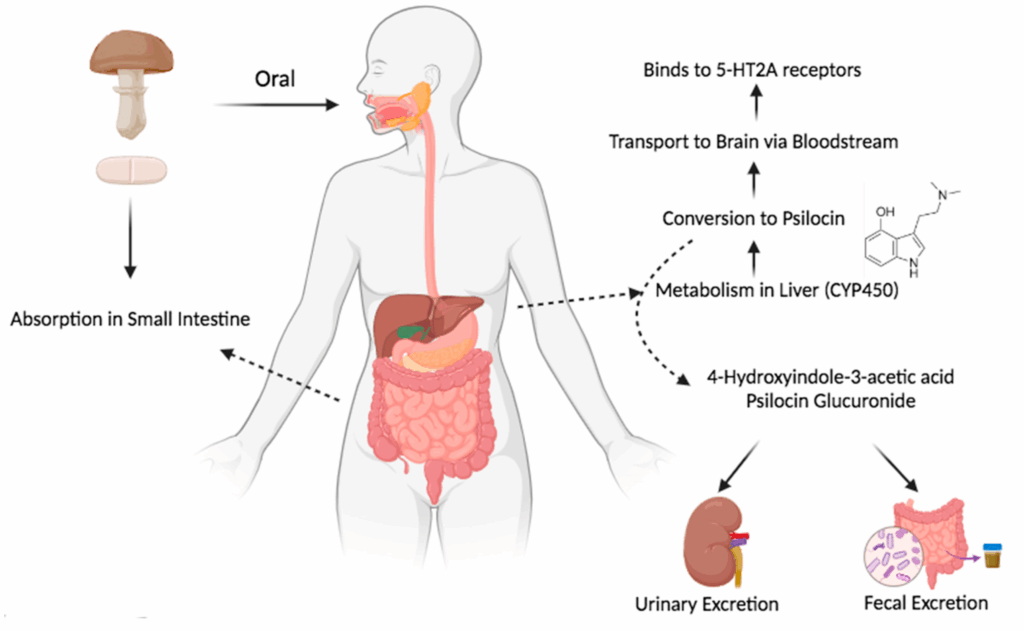
Psilocybin is a prodrug: it is converted to psilocin, which is responsible for most psychoactive effects. Psilocin acts as a serotonin 5-HT2A agonist (among other actions), producing dose-dependent changes in perception, cognition, and mood—effects that overlap strongly with capacities that regulators and road-safety science associate with impaired driving risk.
Acute subjective effects for many users fall into a rough window of about 4–6 hours for a full-dose experience, with meaningful individual variation based on dose, route of administration, stomach contents, individual metabolism, and set/setting. For a general timeline of onset, peak, and comedown, see our guide: How Long Do Shrooms Last?
But “the trip ended” does not automatically mean “safe to drive.” Subtle effects—emotional afterglow, mild visual “sparkle,” slowed cognition, or fatigue—can persist longer than the obvious psychedelic phase.
The Same-Day Driving Question: A Harm-Reduction Default
If you are looking for a practical default that prioritizes safety and legal risk reduction:
- Do not drive during the acute effects or the comedown.
- Do not drive the same day as a full-dose psilocybin session if there is any doubt about your baseline.
- Plan ahead: arrange transportation before the experience begins.
Why so conservative? Because public roads mix unpredictability (other drivers, pedestrians, weather) with high stakes. Psilocybin’s effects are not reliably linear—people can feel “clear enough” while still having measurable cognitive and perceptual changes. If your goal is responsible use, separate the session from driving entirely.
Sleep After Psilocybin: Why It’s Often the Real Bottleneck
Even when subjective effects fade, people often report:
- Difficulty falling asleep for many hours after ingestion
- Restless or shallow sleep if sleep happens too early
- Mental activation—racing thoughts, emotional processing, replay—after intense experiences
That matters for driving because sleep deprivation itself impairs reaction time and attention in ways that can resemble intoxication. A person who finishes a late-night session with little sleep may be impaired the next morning even if psilocybin is no longer pharmacologically “active” in the way it was at hour three.
Practical takeaway: treat “I slept poorly” as a reason to delay driving until you are genuinely rested—not merely “awake.”
Residual Effects & Afterglow: When You Feel “Fine” But Aren’t Baseline
Many users describe an afterglow: improved mood, openness, emotional sensitivity, or a sense of clarity the day after. That can feel pleasant—and it can still coincide with:
- Reduced tolerance for stress or overstimulation
- Emotional sensitivity that can spike in conflict or surprise situations
- Subtle perceptual changes in some individuals (especially in low light)
Afterglow is not the same as “zero impairment.” It is a different state than ordinary baseline, even when it feels positive.
Also worth naming carefully: a small minority of people report longer-lasting visual phenomena or perceptual oddities after psychedelic use. If anything like that is present, driving is inappropriate until resolved—and if symptoms persist, that’s a reason to seek qualified medical advice.
Next-Day Focus: What People Notice (and Why It Varies)
Some people report sharp focus the day after; others feel foggy, tired, or emotionally raw. Contributing factors often include:
- Sleep quantity and quality
- Hydration and food during/after the session
- Stress level of the experience itself (beautiful but intense sessions can still deplete you)
- Co-use of other substances (including alcohol or cannabis), which can compound impairment and sleep disruption
If your next-day goal includes work, childcare, or travel, plan conservatively. And if your next-day includes driving, the conservative standard is: you should feel completely normal in attention, reaction, and emotional regulation—not “good enough.”
Legal Reality in Canada (High Level)
In Canada, law enforcement can investigate drug-impaired driving using standardized field sobriety testing and drug screening technologies where applicable. The practical point for readers is simple: impaired driving is a serious criminal offence, and “I waited X hours” is not a reliable defence if you are impaired.
This article cannot interpret your personal legal risk; it can only emphasize that sobriety for driving means unimpaired, not “mostly down.”

If You Must Travel: Safer Alternatives to Driving
- Sober driver arranged in advance
- Rideshare/taxi
- Transit where available
- Stay overnight where you are, if possible
The best trip is the one that never puts you in a position to make a high-stakes decision while altered—or while sleep-deprived after being altered.
Quick Comparison: Why Psilocybin Is Not “Like Having a Beer” for Driving
People sometimes compare drugs using social drinking as a mental model. That model fails here for several reasons: psychedelic impairment can be perceptual and cognitive in ways that don’t feel like “intoxication” in the alcohol sense; confidence is unreliable; and the duration curve doesn’t match a simple blood-alcohol style decline for many users.
So don’t translate the experience into a false sense of readiness. If you’re asking whether you’re okay to drive, that uncertainty itself is a signal to wait.
Frequently Asked Questions
Is there a standard number of hours after psilocybin when driving is safe?
There is no universally safe number. Effects vary by dose, individual, route, sleep, and co-use. Harm-reduction planning should assume no same-day driving for full-dose experiences unless you have a rigorous, personal baseline—and even then, many people choose next-day-only as a rule.
Can I drive the morning after if I slept?
Sleep helps, but it is not automatic proof of fitness to drive. If you slept poorly, feel foggy, or feel emotionally unsettled, delay. If you feel completely baseline, you still must ensure you are not impaired.
Does microdosing change the driving answer?
If a person is taking any amount of a psychoactive substance that could impair attention or perception, driving may be unsafe and illegal. Many people treat microdosing as incompatible with driving for the same reasons—especially because “sub-perceptual” is subjective.
What if I feel totally sober?
Feeling sober is not always reliable. If there is any residual visual strangeness, slowed thinking, or strong emotional volatility, do not drive.
Where can I read more about duration and effects?
Start with How Long Do Shrooms Last? and our Do’s & Don’ts for a Magic Mushroom Trip for preparation and setting.
The Bottom Line
Psilocybin can be profound. It can also leave you tired, emotionally open, perceptually altered, or sleep-deprived—any of which can make driving unsafe even when the main effects seem over.
The clearest harm-reduction message is also the least glamorous: keep driving out of the equation until you are fully rested, fully baseline, and certain you are unimpaired—and when planning a session, assume you will not be the one behind the wheel that day.
Explore more educational guides on our Magic Mushroom Blog, and browse our shop responsibly in line with the laws that apply to you.
Buy The Best Magic Mushrooms in Canada (19+)
Sources
- Nichols, D.E. — Psilocybin and serotonin 5-HT2A receptor pharmacology (classic psychedelic mechanism overview). Peer-reviewed reviews and chapters on psychedelic pharmacology.
- Carhart-Harris, R.L. et al. — Psilocybin neuroimaging and network neuroscience (context for perceptual/cognitive effects). See e.g. Proceedings of the National Academy of Sciences and related work from Imperial College London’s Centre for Psychedelic Research.
- Government of Canada — Impaired driving (drugs/alcohol) resources: Impaired driving overview
- Health Canada — Psilocybin and public health framing (legal status and health information): search Health Canada for current psilocybin-related pages.
Disclaimer: This article is for general education and harm reduction. It is not medical or legal advice. Psilocybin is regulated/illegal in many contexts; laws vary by jurisdiction. Never drive impaired. If you have health concerns, consult a qualified professional.