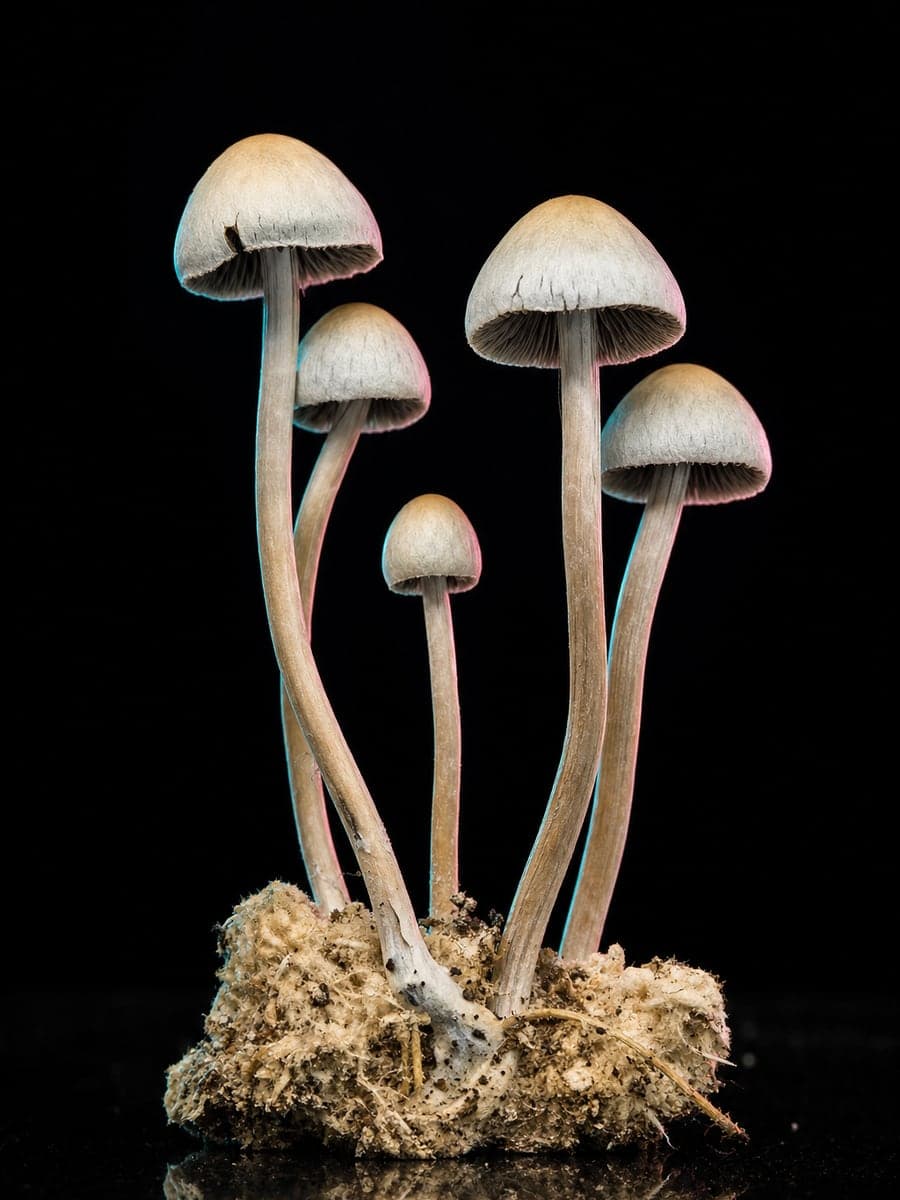
Panaeolus Cyanescens
A slender grey dung mushroom, not a cubensis at all.
Its accepted name is Panaeolus cyanescens (Berk. & Broome) Sacc., published by Saccardo in 1887; it is also filed under the older genus name Copelandia as Copelandia cyanescens. It belongs to a different genus from Psilocybe cubensis.
Vendors sell a line called Tamarind Tree BVI, said to come from the British Virgin Islands and to test around 2.5% total tryptamines; we found no published test of that line.
Where Panaeolus Cyanescens comes from
Panaeolus cyanescens is a separate species from Psilocybe cubensis: a small, slender, grey-capped mushroom that grows on dung across the tropics and subtropics. Often called Pan Cyan or Blue Meanies (not to be confused with the cubensis strain Blue Meanie), it has some of the highest psilocin figures published for any mushroom, from a German customs laboratory.
- Origin
- Pantropical: found on dung in the tropics and subtropics of the Americas, Africa, Asia and Oceania, and in the southern United States · Described in the 19th century; placed in Panaeolus by Saccardo in 1887
- Family
- Other species · Unknown · Uncommon
- Lineage
- A species, not a bred strain. Growers keep named collections of it, such as Tamarind Tree BVI, Hawaiian and Peace River.
Its accepted name is Panaeolus cyanescens (Berk. & Broome) Sacc., published by Saccardo in 1887; it is also filed under the older genus name Copelandia as Copelandia cyanescens. It belongs to a different genus from Psilocybe cubensis.
Mushroom Observer: Panaeolus cyanescens name recordWikipedia: Panaeolus cyanescens (as a pointer)It grows on dung in both the New World and Old World tropics, with records from Southeast and South Asia, Africa, Australia, the Pacific islands, the Caribbean, Central and South America, and the southern United States.
Wikipedia: Panaeolus cyanescens, Distribution and habitat (as a pointer)A German customs laboratory that analysed seized mushrooms found the highest psilocin levels in dried Panaeolus cyanescens, up to about 3.0 mg per 100 mg (about 3% of dry weight). Wikipedia's summary of the same paper adds a psilocybin figure of about 2.5% across 25 samples.
Laussmann & Meier-Giebing (2010), Forensic Science International 195: 160–164 (PubMed abstract)Wikipedia: Panaeolus cyanescens, Psychoactive properties (as a pointer)It is grown in laboratories for research: a 2021 South African study cultivated it alongside Psilocybe natalensis and two P. cubensis lines to test hot-water extracts on human immune cells in vitro.
Nkadimeng et al. (2021), Journal of Inflammation Research 14: 3729–3738 (PubMed abstract)Growers on Shroomery in 2005 called this species the 'real' Blue Meanies and blamed a spore vendor for giving the name to a cubensis strain. A 2007 reply in the same thread said the Australian Blue Meanie is not cubensis, and is specifically the tropicalis form of Panaeolus.
Shroomery forum: 'is there such thing as a blue meanie cubensis?' (2005–2007)Cultivated collections circulate under place names: a strain index lists Tamarind Tree BVI, Estero, Hawaiian and Huasteca, and the Wumbo Genetics guide describes Pan Cyan Peace River, a wild collection from a Florida riverbank, as needing plenty of fresh air and a shallow manure or straw substrate.
Mycopedia: Panaeolus Cyanescens (secondary index)Wumbo Genetics strain guide (2023, vendor page)
Vendors sell a line called Tamarind Tree BVI, said to come from the British Virgin Islands and to test around 2.5% total tryptamines; we found no published test of that line.
Pan Cyans have a reputation among growers for being fussier than cubensis, wanting more fresh air and a manure-rich substrate.
What it looks like
- Caps
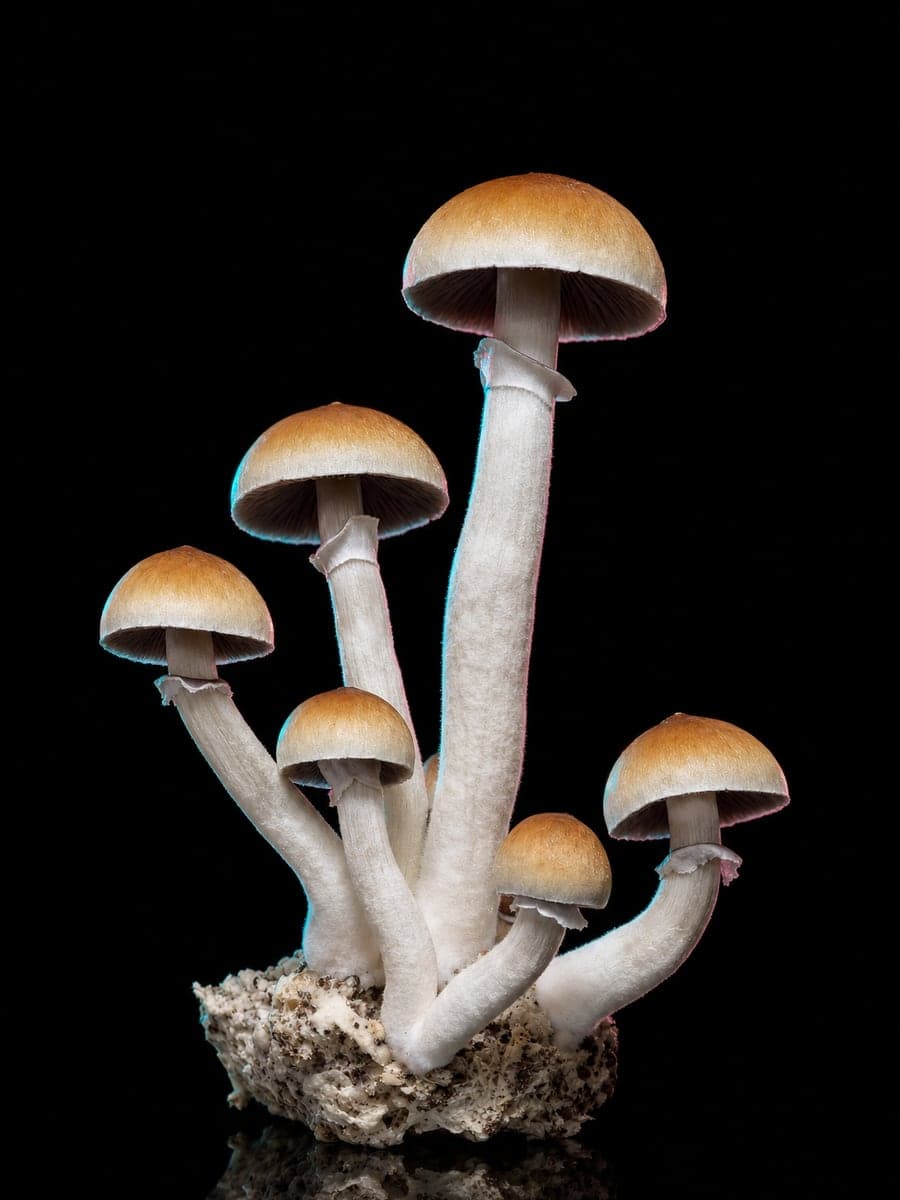
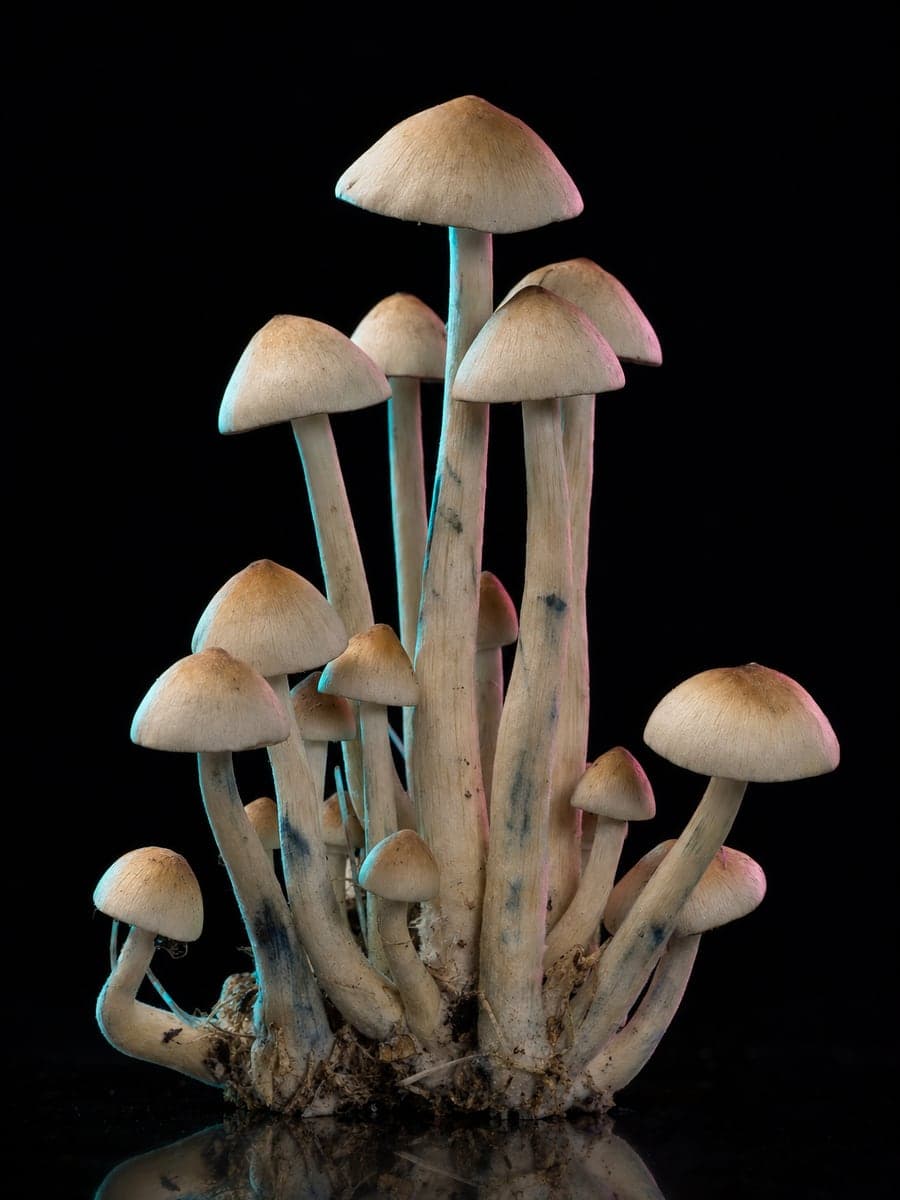
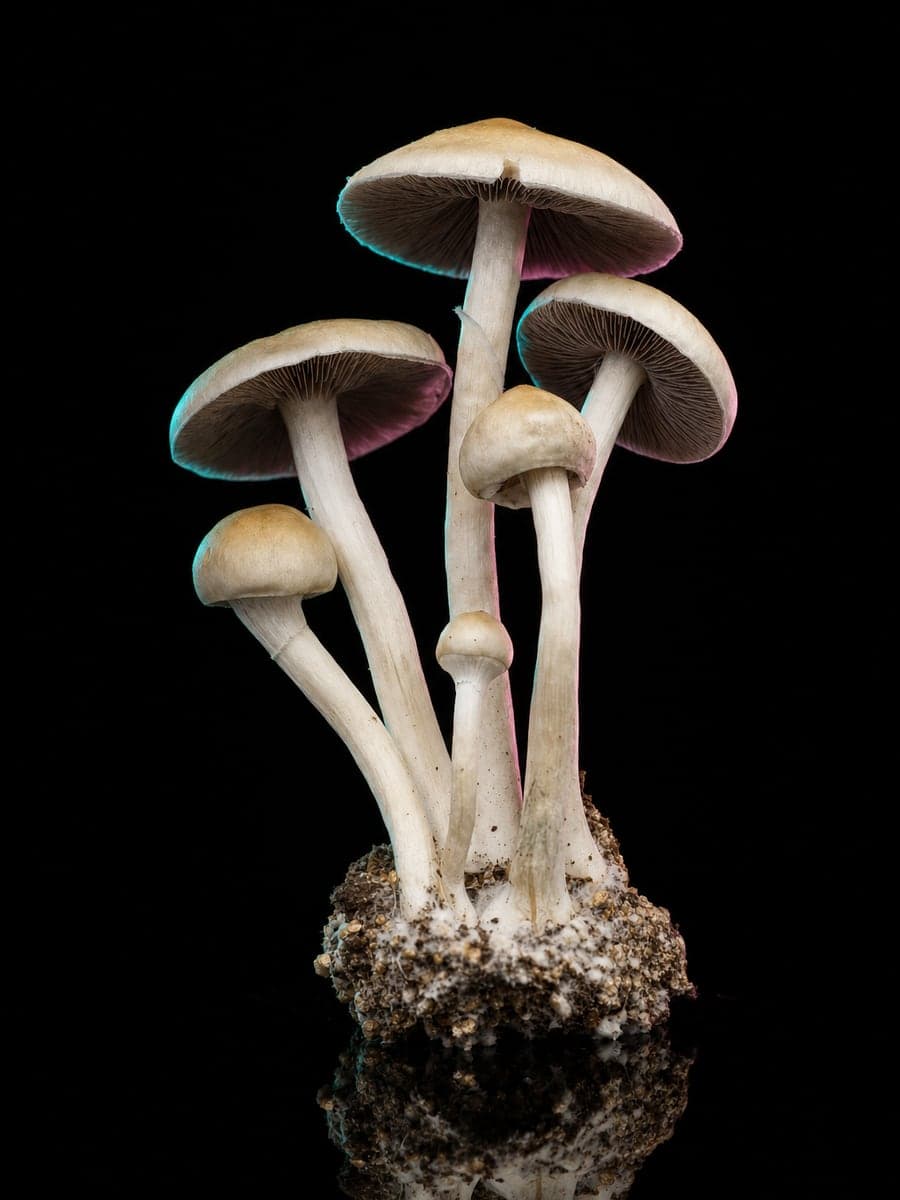
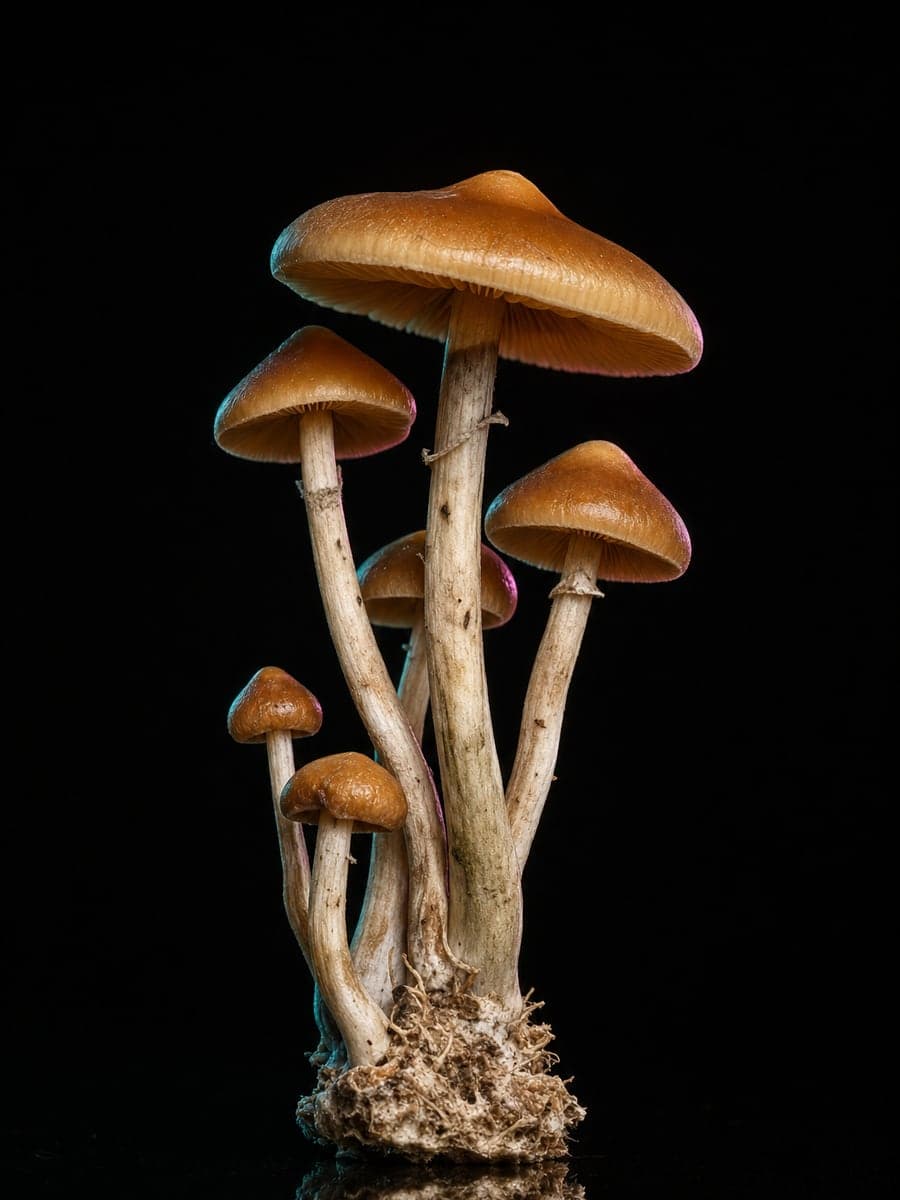
- Small, 1.5–4 cm across, hemispheric at first and opening to bell-shaped or convex. Light brown when young, fading to off-white or pale grey, often cracking in dry weather.
- Stems
- Long and very thin (about 6–12 cm by 2–4 mm), coloured like the cap, with a fine powdery bloom.
- Notes
- Gills start grey and turn mottled black as the spores ripen, with white edges; the spore print is black, unlike the purple-brown print of cubensis. Caps and stems stain blue to blue-black where handled.
- Growing
- Grown far less often than cubensis. Guides describe it as wanting lots of fresh air and a shallow manure or straw-based substrate, and producing many small, thin fruits.
How it is described
Pan Cyan has a reputation as much stronger by weight than cubensis, with a quick onset. It is commonly described as brightly visual and cheerful, with less body load than cubensis. Strength varies a great deal between collections and grows.
Based on: Forensic lab data on seized samples (Laussmann & Meier-Giebing 2010) for potency; the feel is general reputation as summarised in the Shroom Bros product notes. No controlled data on effects.
Panaeolus Cyanescens, asked and answered
Is Panaeolus cyanescens a cubensis strain?
No. It is a different species in a different genus, Panaeolus. It looks nothing like cubensis: small grey bell-shaped caps on long, thin stems, and a black spore print.
Where does Panaeolus cyanescens come from?
It grows wild on dung across the tropics and subtropics, from Southeast Asia, Africa and Australia to the Caribbean, Latin America and the southern United States. Cultivated lines are named after where they were collected, such as Hawaiian or Tamarind Tree BVI.
What does Panaeolus cyanescens look like?
Caps a few centimetres wide, light brown when young and fading to off-white or pale grey, on long stems only a few millimetres thick. The gills turn mottled black and the flesh stains blue-black where handled.
Is Panaeolus cyanescens strong?
It has a reputation as one of the strongest psilocybin mushrooms. A German customs lab measured up to about 3% psilocin in dried samples, well above typical cubensis figures. Strength varies between collections.
Is it the same as Blue Meanie?
No. Blue Meanies is an old common name for this species and its close relatives. Blue Meanie is also the name of an unrelated cubensis strain, which is a separate entry in the Shroomdex.
Can I pick it in the wild?
It grows wild, but small grey and brown mushrooms on dung and lawns include toxic and even deadly look-alikes. Never pick a wild mushroom based on a picture or a description.
The Shroomdex records history and reputation, not advice: how a strain is described is never a promise of how it will feel, and nothing here is medical advice. Strength varies from batch to batch. Start low and see our dose calculator. Never forage from a website: deadly look-alikes grow wild.