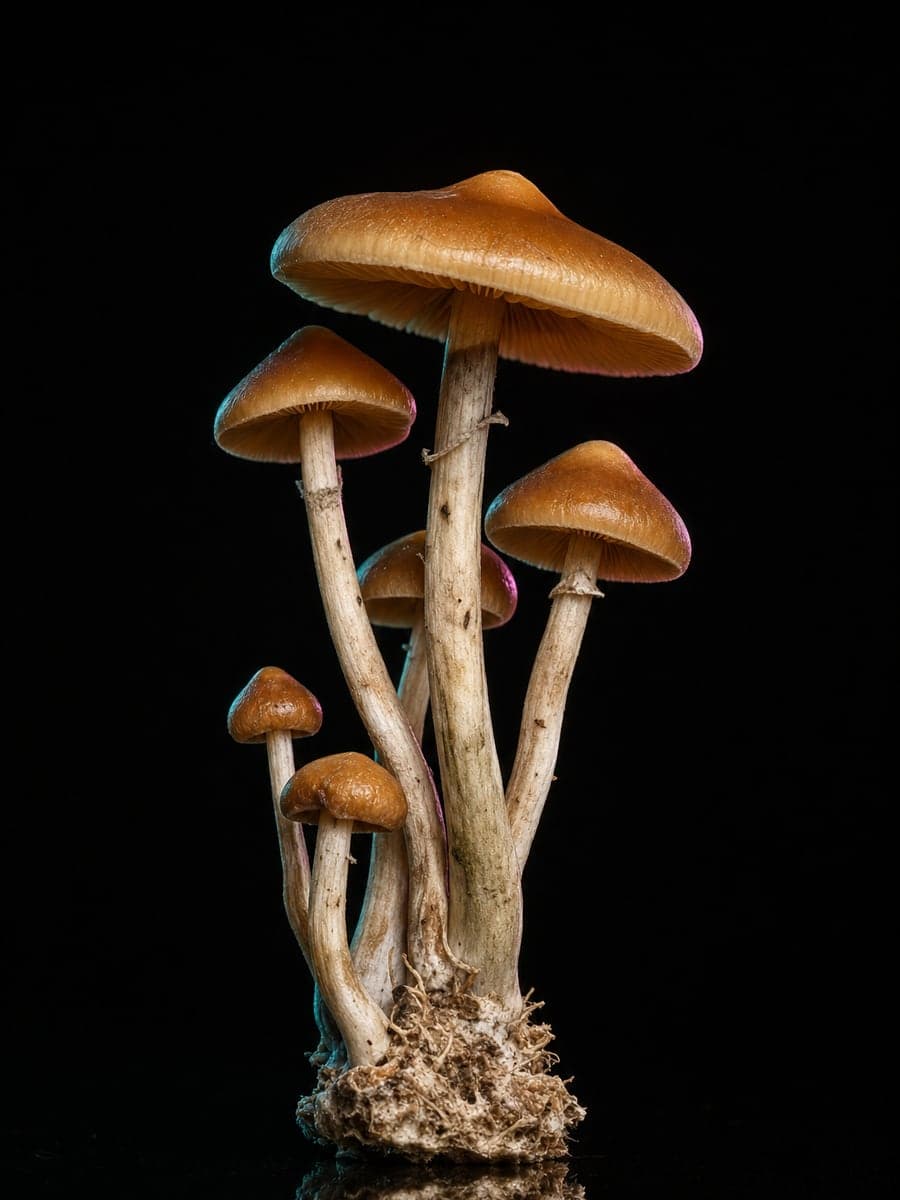
Psilocybe azurescens
A coastal woodlover with very high measured psilocybin.
Paul Stamets and Jochen Gartz described the species in 1995 as 'a new caerulescent Psilocybe from the Pacific Coast of Northwestern North America', in the journal Integration.
The usual story says the first specimens were noticed by a group of Boy Scouts near Astoria in the late 1970s.
Where Psilocybe azurescens comes from
Psilocybe azurescens is a wood-loving species from a small stretch of the Pacific coast around the mouth of the Columbia River in Oregon and Washington. It was described by Paul Stamets and Jochen Gartz in 1995 and is often cited as one of the most potent psilocybin mushrooms, with measured psilocybin up to about 1.8%. It is a wild mushroom with deadly look-alikes.
- Origin
- Pacific coast of the USA around the Columbia River mouth; type collections from Hammond, near Astoria, Oregon · Described 1995
- Family
- Other species · Americas · Uncommon
- Lineage
- A species, not a cultivated strain. DNA places it among near-identical close relatives: P. cyanescens, P. allenii and the Australasian P. subaeruginosa complex.
Paul Stamets and Jochen Gartz described the species in 1995 as 'a new caerulescent Psilocybe from the Pacific Coast of Northwestern North America', in the journal Integration.
Erowid: comparative potency chart, citing Stamets & Gartz (1995), Integration 6Guzmán, Allen & Gartz (1998/2000), 'A worldwide geographical distribution of the neurotropic fungi', Ann. Mus. civ. Rovereto 14Its known wild range is small: mainly around the Columbia River delta, from about Depoe Bay, Oregon, north to Grays Harbor County, Washington, with type collections from Hammond near Astoria.
Wikipedia: Psilocybe azurescens (pointer)The analysis published with its description gave 1.78% psilocybin, 0.38% psilocin and 0.35% baeocystin by dry weight, the highest psilocybin figure on a chart of species compiled from Paul Stamets' Psilocybin Mushrooms of the World.
Erowid: 'The psilometric scale of comparative potency', from Stamets' Psilocybin Mushrooms of the WorldGotvaldová et al. (2022), Int. J. Mol. Sci. 23: 14068 (cites up to 17.8 mg/g psilocybin)DNA studies find P. azurescens almost identical in sequence to P. cyanescens, P. allenii and P. weraroa, and a 2024 study of 89 genomes places northern-hemisphere woodlovers among Australian populations of P. subaeruginosa, suggesting the whole group came from Australasia and spread with woodchips and plants.
Borovička et al. (2015), Persoonia 34 (phylogeny of Psilocybe)McTaggart et al. (2024), 'Wood-loving magic mushrooms from Australia are saprotrophic invaders in the Northern Hemisphere', Fungal Systematics and Evolution 14Temporary weakness or paralysis, known as 'wood lover's paralysis', has been reported anecdotally after eating this and related woodlovers. A 2024 genome study notes there is no evidence linking it to the psilocybin pathway.
Wikipedia: Psilocybe azurescens (pointer)McTaggart et al. (2024), Fungal Systematics and Evolution 14It is grown outdoors on wood-chip beds; one well-documented home cultivation report describes spawning hardwood sawdust and alder chips and planting patches in garden beds in summer to fruit in autumn.
Erowid: 'P. azurescens Cultivation Report' (submitted by Amanita)
The usual story says the first specimens were noticed by a group of Boy Scouts near Astoria in the late 1970s.
The name 'flying saucer mushroom' is usually put down to the broad, knobbed cap seen from above.
What it looks like
- Caps
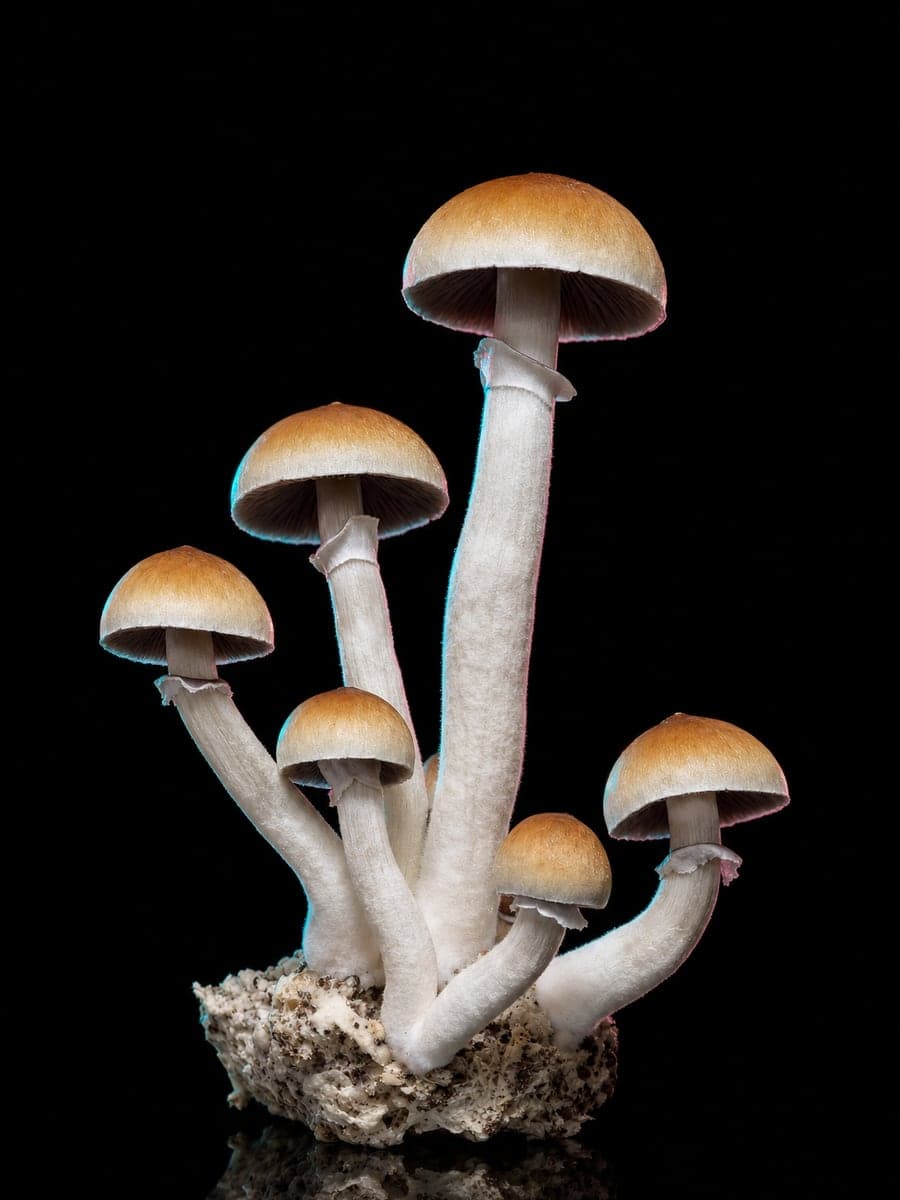
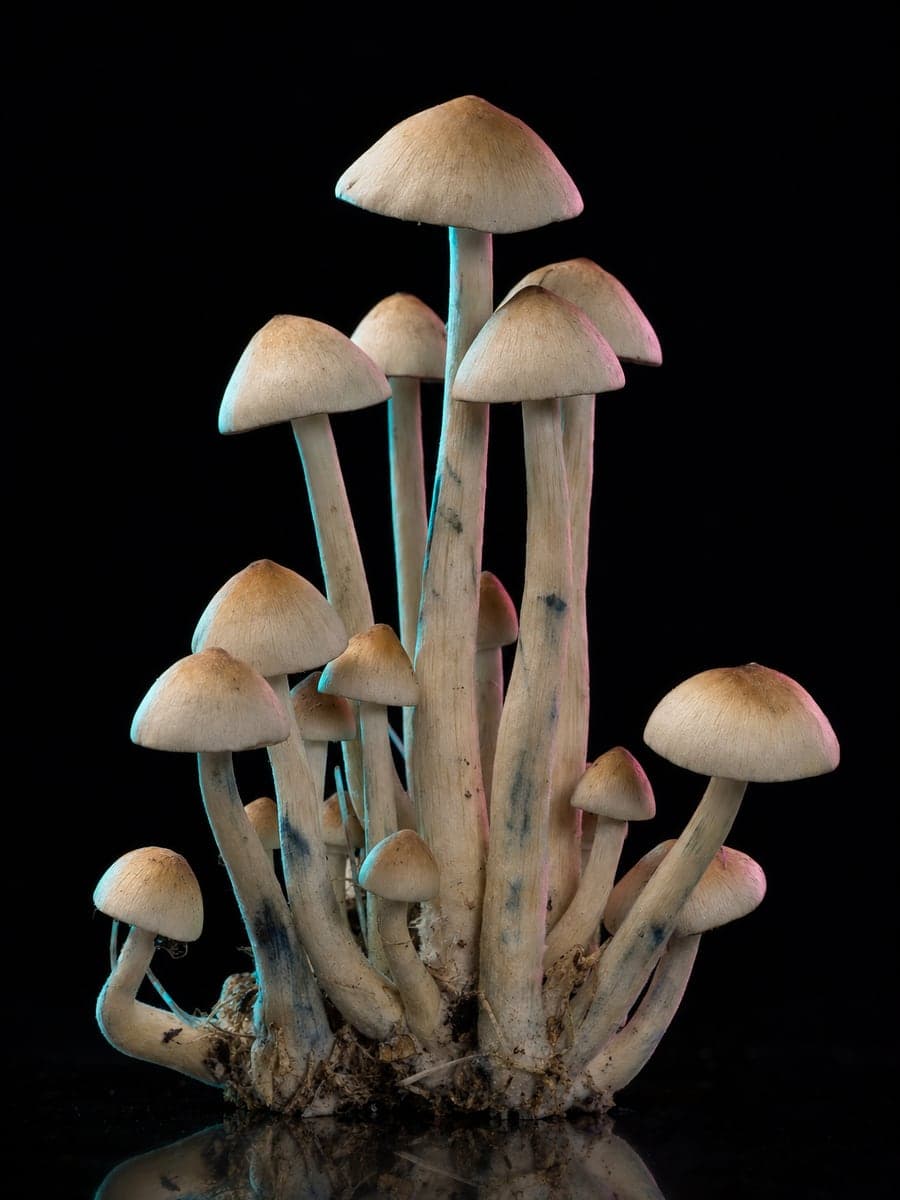
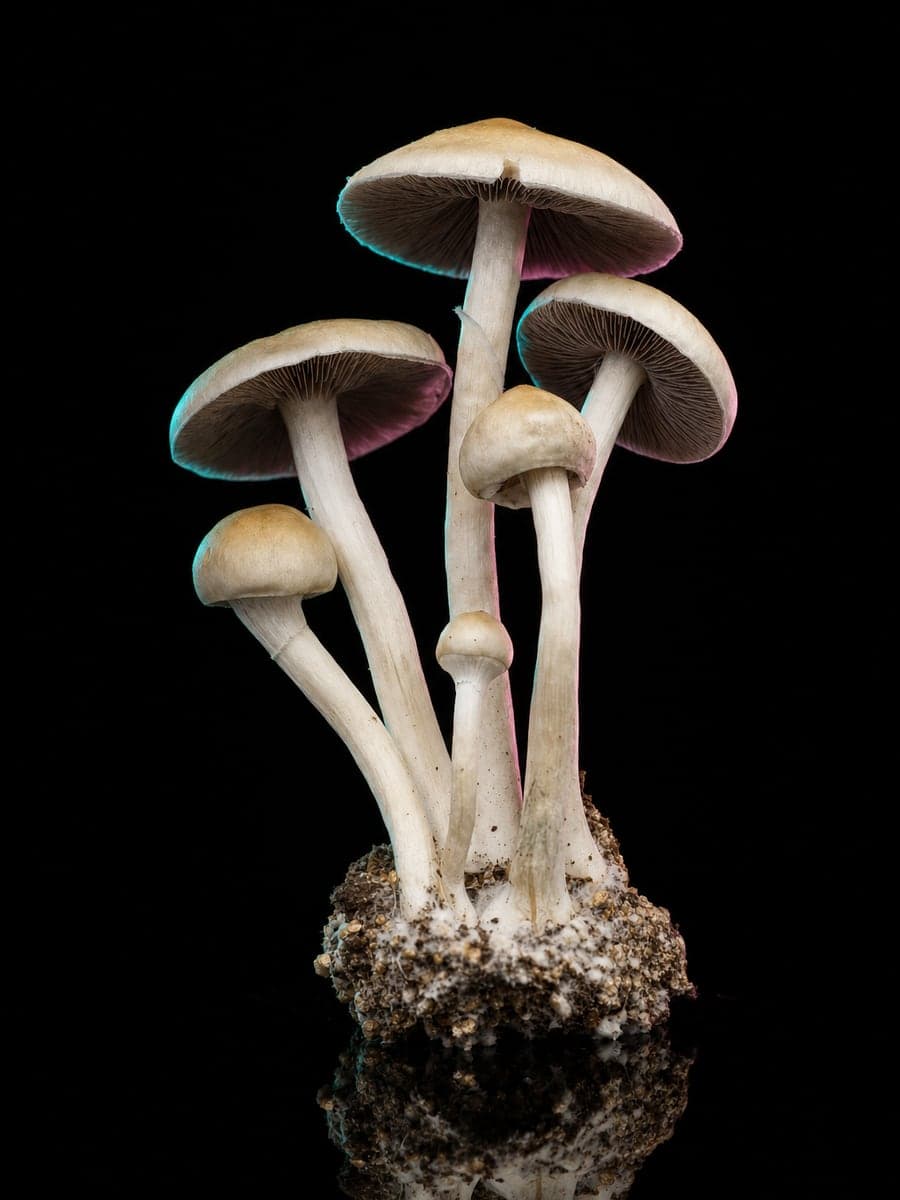
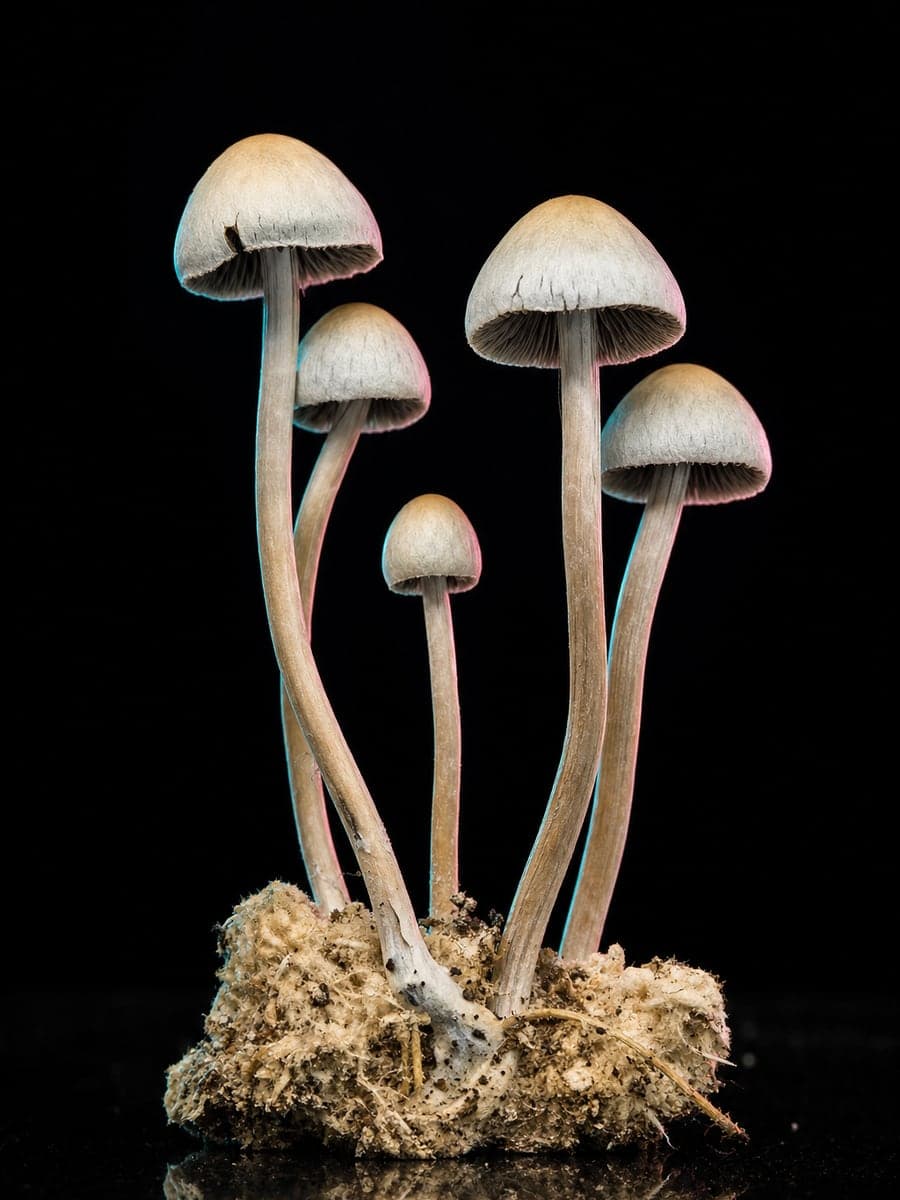
- 3–10 cm, conic to convex then flattening, with a broad, persistent knob in the centre. Smooth and slippery when wet, chestnut to caramel brown, drying to pale straw; often pitted with dark blue patches.
- Stems
- Long (9–20 cm) and fairly thin, silky white turning dingy brown with age, often curved, the base thickened and tufted with white mycelium.
- Notes
- Bruises strongly blue. Dark purple-brown spore print. Fruits in late autumn on wood chips and in sandy soil full of buried wood, often in dune grass.
- Growing
- Grown outdoors on hardwood chip beds in cool climates; it needs a cold autumn to fruit, so indoor fruiting is hard.
How it is described
Psilocybe azurescens has a reputation as one of the strongest psilocybin mushrooms known, backed by unusually high lab figures. Write-ups about it often mention wood lover's paralysis, a temporary weakness reported anecdotally after eating woodlovers.
Based on: Published lab analyses (Stamets & Gartz 1995, via Erowid's chart) for potency; reputation from mycological write-ups. No controlled data on effects; other axes left at the middle.
Psilocybe azurescens, asked and answered
Where does Psilocybe azurescens come from?
A small area of the Pacific coast around the mouth of the Columbia River in Oregon and Washington, where it grows in dune grass and on buried wood. Paul Stamets and Jochen Gartz described it in 1995.
What does Psilocybe azurescens look like?
Caramel to chestnut caps with a broad central knob, slick when wet and drying pale, on long, silky white stems. It bruises dark blue.
Is Psilocybe azurescens strong?
It has some of the highest psilocybin levels ever measured in a mushroom: up to about 1.8% in the analysis published with its description. Strength varies with conditions and age.
Can I pick Psilocybe azurescens in the wild?
It is a wild mushroom, and small brown mushrooms on wood, including the deadly Galerina, grow in the same places. Never pick a wild mushroom to eat from a picture; only an expert identification, with a spore print, can tell them apart.
The Shroomdex records history and reputation, not advice: how a strain is described is never a promise of how it will feel, and nothing here is medical advice. Strength varies from batch to batch. Start low and see our dose calculator. Never forage from a website: deadly look-alikes grow wild.