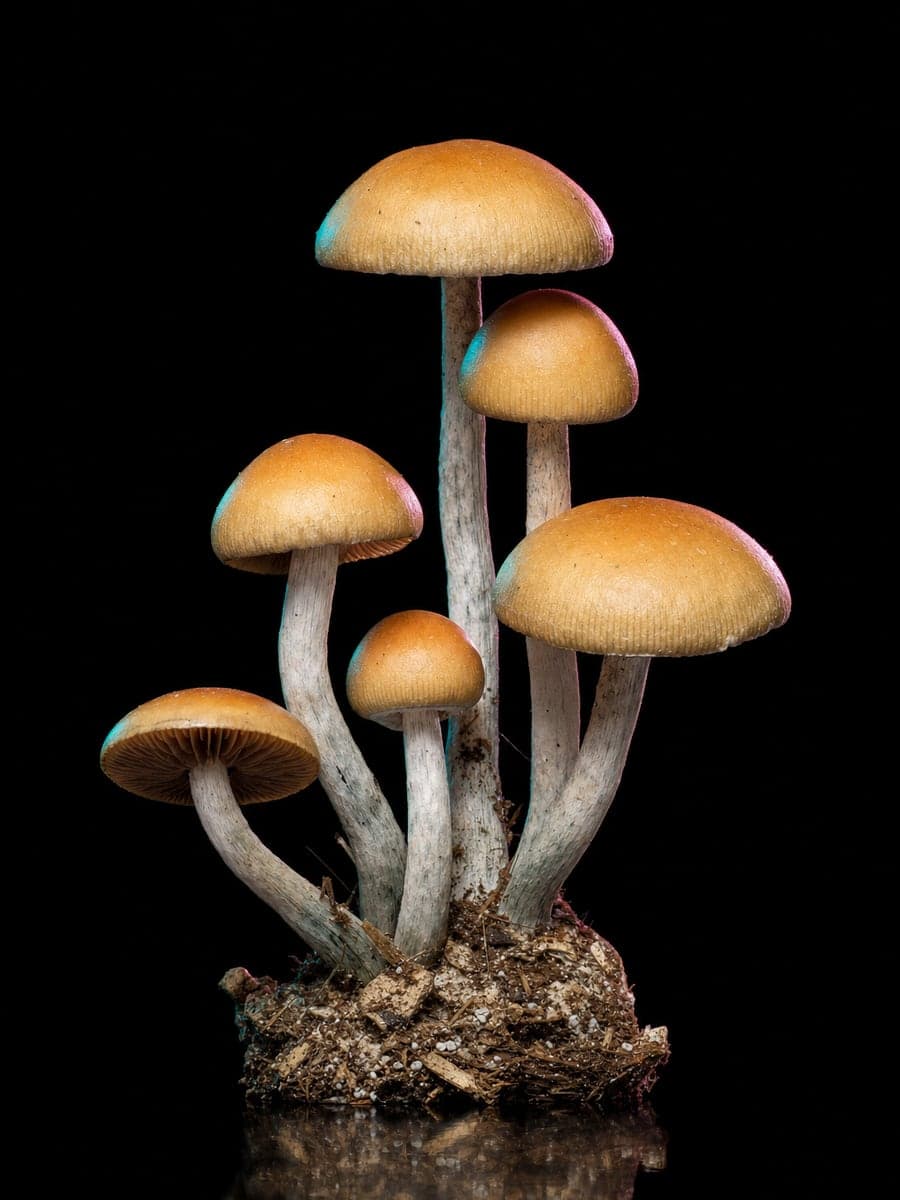
Psilocybe allenii
The Bay Area woodlover named only in 2012.
Jan Borovička, Alan Rockefeller and Peter G. Werner described it as new in 2012 in Czech Mycology, separating it from P. cyanescens by its unwavy cap edge and a five-base difference in its ITS DNA. It honours John W. Allen, who collected the type material in Seattle in 2009.
Rockefeller has joked that Golden Gate Park fills with hunters every December, searching the wood-chip beds for it and P. cyanescens.
Where Psilocybe allenii comes from
Psilocybe allenii is a wood-loving psilocybin mushroom of the Pacific coast of North America, from British Columbia to Los Angeles, that grows on wood-chip landscaping. Long known to San Francisco pickers by the invalid name 'cyanofriscosa', it was formally described in 2012 and named after ethnomycologist John W. Allen. It is a wild mushroom with deadly look-alikes.
- Origin
- Pacific coast of North America, British Columbia to Los Angeles, mostly within about 16 km of the sea; type collected on the University of Washington campus, Seattle · Described 2012; known informally since at least 2006
- Family
- Other species · Americas · Uncommon
- Lineage
- A species, not a cultivated strain. Its DNA differs from P. cyanescens by only a few bases in the ITS region.
Jan Borovička, Alan Rockefeller and Peter G. Werner described it as new in 2012 in Czech Mycology, separating it from P. cyanescens by its unwavy cap edge and a five-base difference in its ITS DNA. It honours John W. Allen, who collected the type material in Seattle in 2009.
Wikipedia: Psilocybe allenii (pointer to Czech Mycology 64(2), 2012)San Francisco Bay Guardian: interview with Alan Rockefeller and Peter Werner (Dec 2012)Rockefeller told the San Francisco Bay Guardian that Bay Area pickers had called it 'Psilocybe cyanofriscosa' since 2006, a name never validly published, and that a 1976 Paul Stamets photo from Golden Gate Park in David Arora's Mushrooms Demystified shows both species labelled as P. cyanescens.
San Francisco Bay Guardian: interview with Alan Rockefeller and Peter Werner (Dec 2012)Its range runs from British Columbia to Los Angeles, mostly near the coast, on wood chips of oak, eucalyptus, Douglas fir and alder, fruiting in cold weather from about late September to January.
Wikipedia: Psilocybe allenii (pointer)A 2015 phylogeny found P. allenii, P. azurescens, P. cyanescens and P. weraroa almost identical in the DNA regions studied, and a 2024 genome study treats them as one group with Australian P. subaeruginosa.
Borovička et al. (2015), Persoonia 34McTaggart et al. (2024), Fungal Systematics and Evolution 14
Rockefeller has joked that Golden Gate Park fills with hunters every December, searching the wood-chip beds for it and P. cyanescens.
The informal name 'cyanofriscosa' is usually read as a play on San Francisco.
What it looks like
- Caps
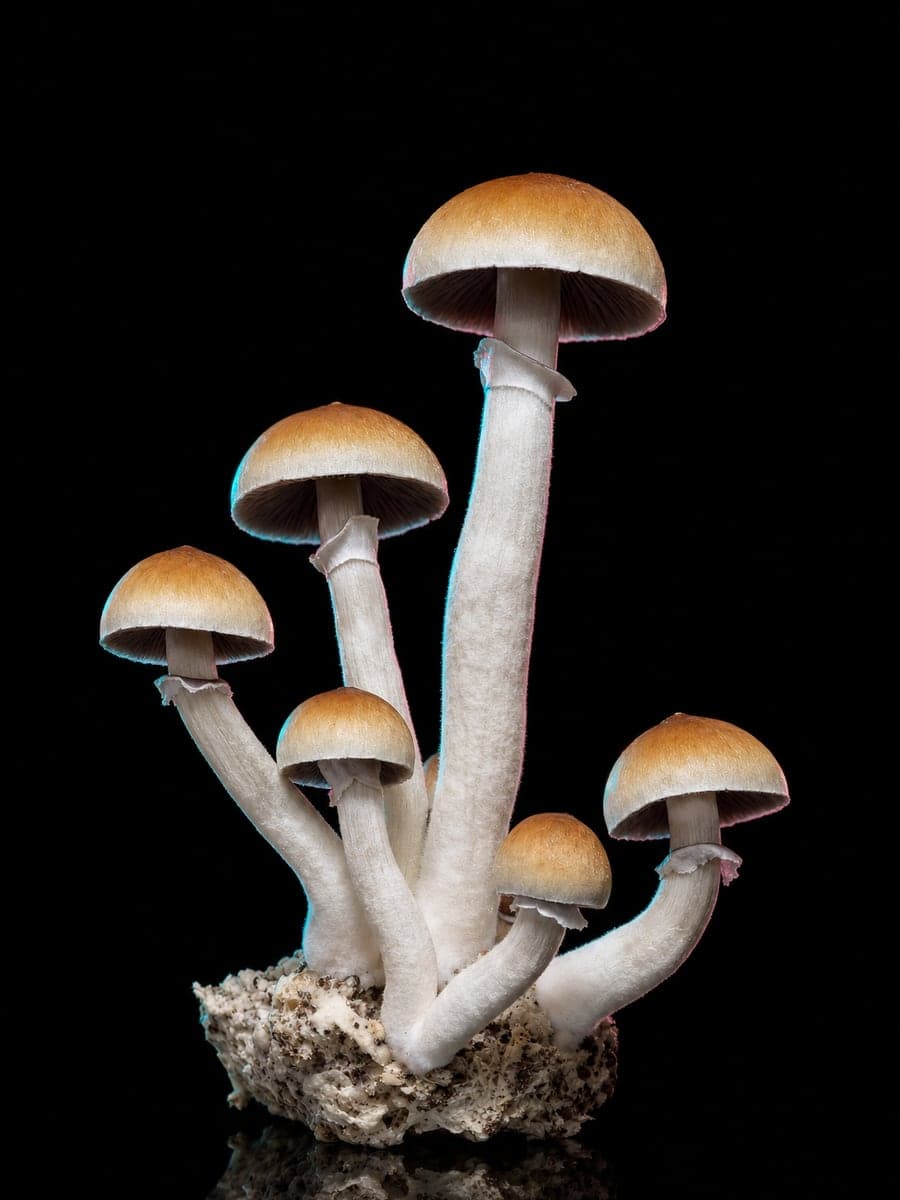
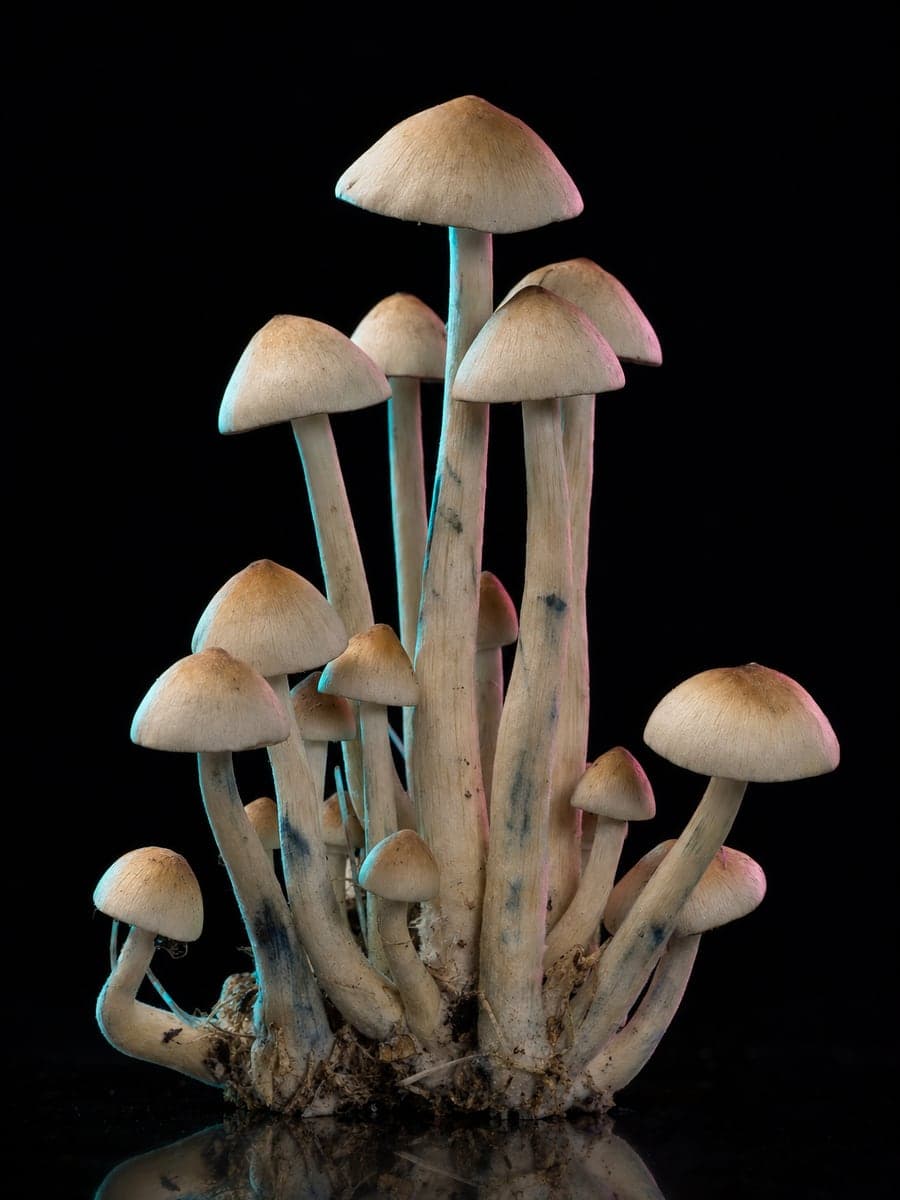
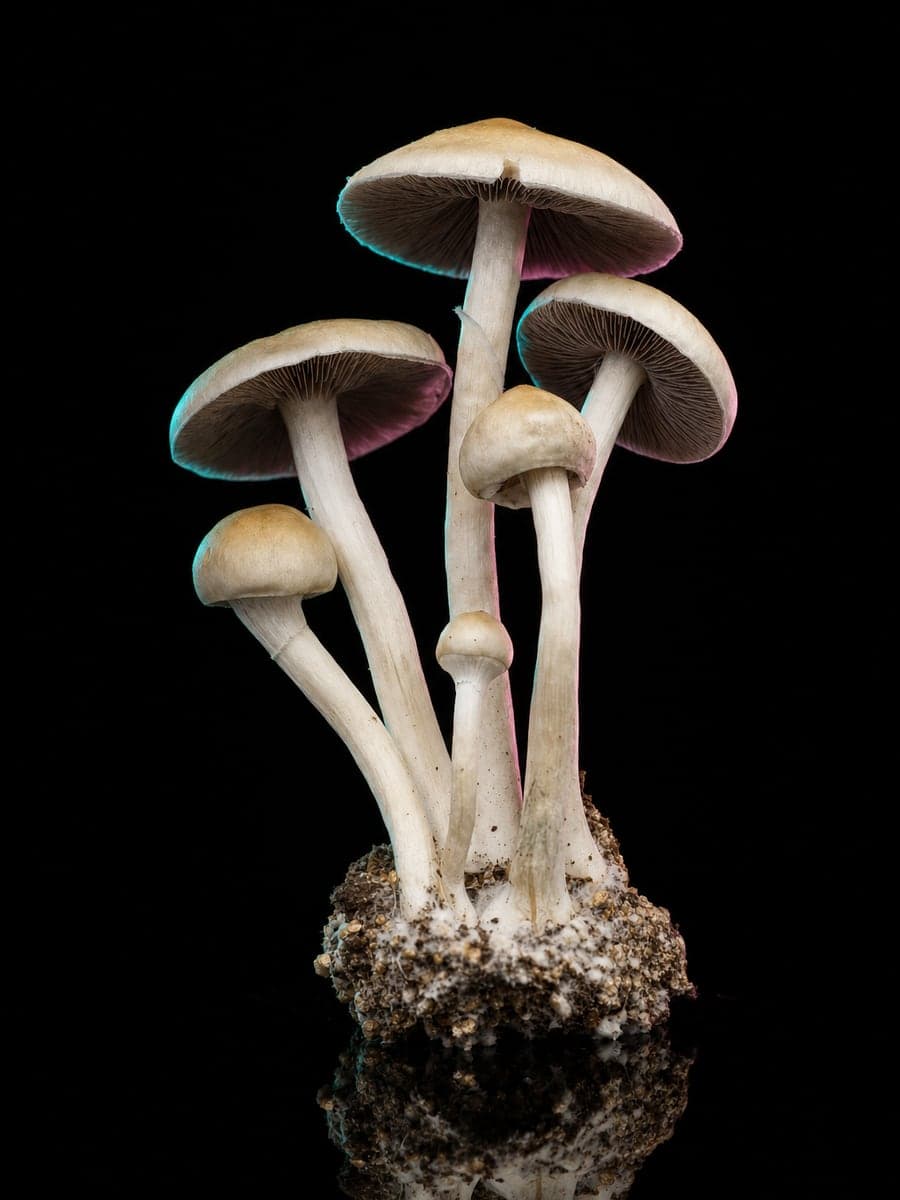
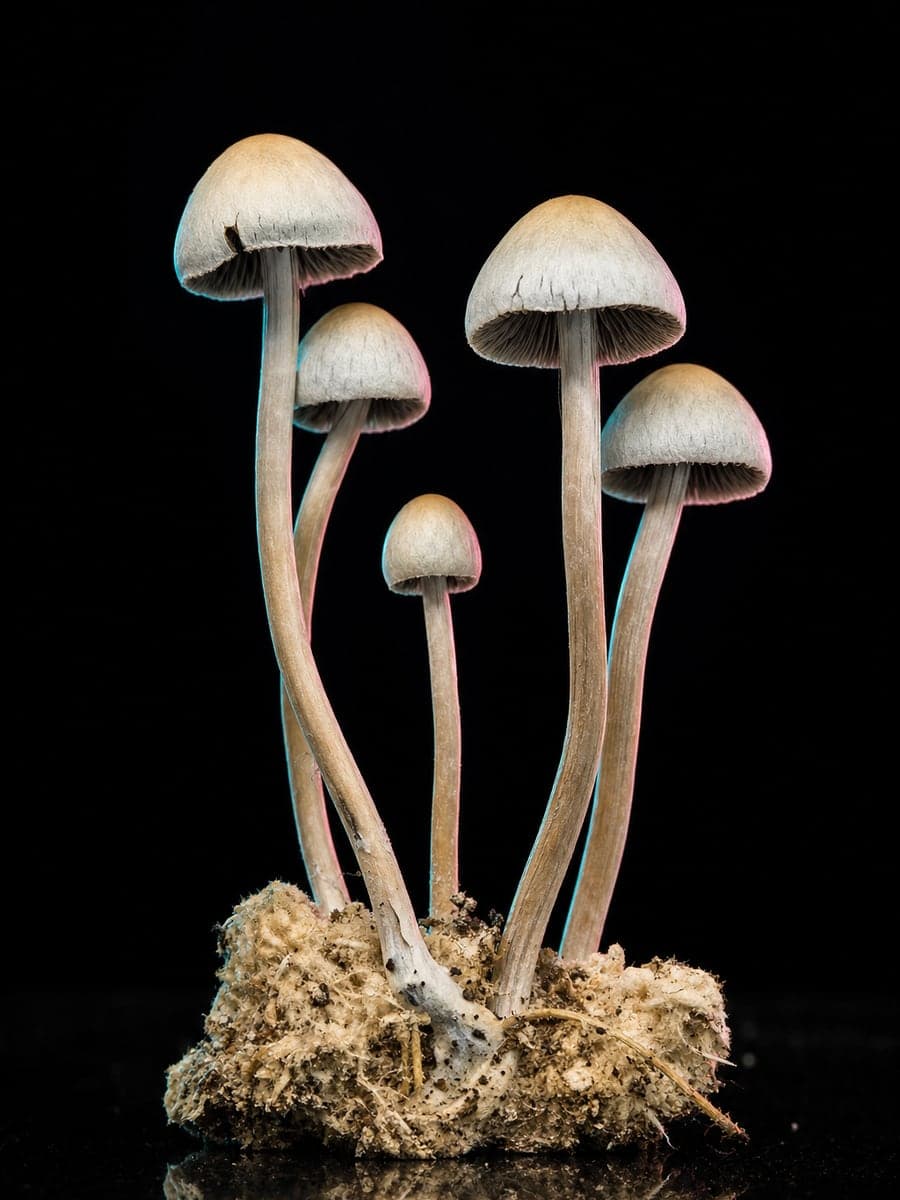
- 1.5–9 cm, broadly convex to flat, pale orange-brown to caramel when wet, drying yellowish-buff; the margin stays straight or slightly incurved, rarely wavy.
- Stems
- White, hollow, 4–7 cm long, slightly thicker at the base, yellowing a little with age.
- Notes
- Slippery, peelable cap skin when wet. Young fruits have a white veil that may leave a faint ring zone. All parts bruise blue. Spore print dark brown with violet tones. The lack of a wavy cap edge is the main field difference from P. cyanescens.
- Growing
- Reported to grow readily in culture on agar, grain and wood chips or sawdust; outdoors it fruits in cold, wet weather on hardwood mulch.
How it is described
Psilocybe allenii has a reputation among Pacific coast pickers as a strong mushroom, roughly on a par with P. cyanescens. Alan Rockefeller has said enthusiasts call it one of the strongest known, with only P. azurescens possibly stronger.
Based on: Reputation as reported by the species' describers (SF Bay Guardian interview, 2012); no published potency figures for P. allenii were found.
Psilocybe allenii, asked and answered
Where does Psilocybe allenii come from?
The Pacific coast of North America, from British Columbia to Los Angeles, mostly in wood-chip landscaping near the sea. It was described in 2012 from material collected in Seattle.
What does Psilocybe allenii look like?
Caramel to orange-brown caps that dry to buff and open broad and flat with a straight edge, on white, hollow stems. Everything bruises blue.
How is it different from Psilocybe cyanescens?
In the field, mainly by the cap: P. cyanescens grows a wavy edge as it matures, P. allenii usually does not. Under the microscope they look the same, and their DNA differs only slightly.
Is Psilocybe allenii strong?
Pickers describe it as strong, similar to P. cyanescens, but no published lab figures for it were found.
Can I pick Psilocybe allenii in the wild?
It is a wild mushroom that grows on wood chips alongside look-alikes such as the deadly Galerina. Never pick a wild mushroom to eat from a picture; only an expert identification, with a spore print, can tell them apart.
The Shroomdex records history and reputation, not advice: how a strain is described is never a promise of how it will feel, and nothing here is medical advice. Strength varies from batch to batch. Start low and see our dose calculator. Never forage from a website: deadly look-alikes grow wild.