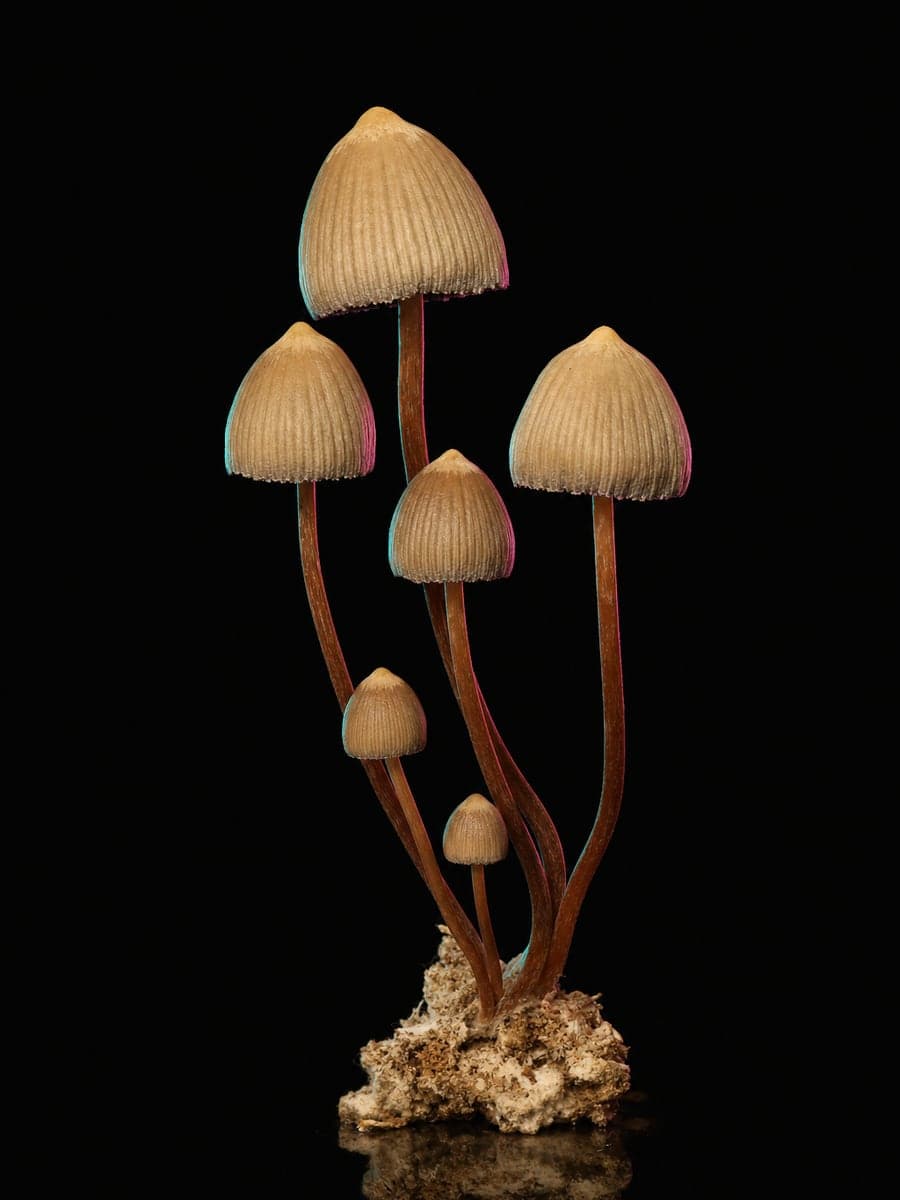
Psilocybe mexicana
The little mushroom psilocybin was first isolated from.
In 1958 Albert Hofmann, Roger Heim, A. Brack and H. Kobel reported psilocybin as the active substance of P. mexicana, isolated from mushrooms grown in the laboratory; psilocin followed.
It is often called the teonanácatl of the Aztecs, usually translated 'flesh of the gods' or 'god mushroom', though that word likely covered several species.
Where Psilocybe mexicana comes from
Psilocybe mexicana is a small, slender psilocybin mushroom of Mexico and Central America, long used in ceremonies. It was from cultivated P. mexicana that Albert Hofmann's team first isolated psilocybin in 1958. It also forms underground truffles, or sclerotia, and is a wild mushroom with deadly look-alikes.
- Origin
- Mexico and Central America (Guatemala; also reported from Costa Rica and El Salvador); grassy meadows and pastures by deciduous woodland · Described by Roger Heim, 1957
- Family
- Other species · Americas · Uncommon
- Lineage
- A species, not a cultivated strain. It gives its name to section Mexicanae, which also holds P. tampanensis and the Thai P. samuiensis.
In 1958 Albert Hofmann, Roger Heim, A. Brack and H. Kobel reported psilocybin as the active substance of P. mexicana, isolated from mushrooms grown in the laboratory; psilocin followed.
Hofmann, Heim, Brack & Kobel (1958), Experientia 14(3): 107–109 (PubMed)The Ones That Stain Blue (stainblue.com): Psilocybe mexicanaTo test whether cultivated mushrooms kept their activity, Hofmann ate some himself and later described a flood of Mexican-styled inner images in The Botany and Chemistry of Hallucinogens.
The Ones That Stain Blue (stainblue.com): Psilocybe mexicana, quoting Schultes & HofmannWikipedia: Psilocybe mexicana (pointer)A 2022 study of DNA-confirmed Mexican collections measured 3.3–3.9 mg/g psilocybin and about 1.9–2.0 mg/g psilocin, which the authors say agrees with Hofmann's historical figures.
Gotvaldová et al. (2022), Int. J. Mol. Sci. 23: 14068Guzmán's checklist places it in Mexico and Guatemala and notes its close relatives P. samuiensis of Thailand and P. makarorae of New Zealand.
Guzmán, Allen & Gartz (1998/2000), Ann. Mus. civ. Rovereto 14: 189–280It grows alone or in small groups among moss and grass in meadows, pastures and roadsides near deciduous woods, fruiting from May to October; its sclerotia are cultivated in the West.
The Ones That Stain Blue (stainblue.com): Psilocybe mexicanaWikipedia: Psilocybe mexicana (pointer)
It is often called the teonanácatl of the Aztecs, usually translated 'flesh of the gods' or 'god mushroom', though that word likely covered several species.
It is commonly linked with the Mazatec healer María Sabina's veladas in Oaxaca.
What it looks like
- Caps
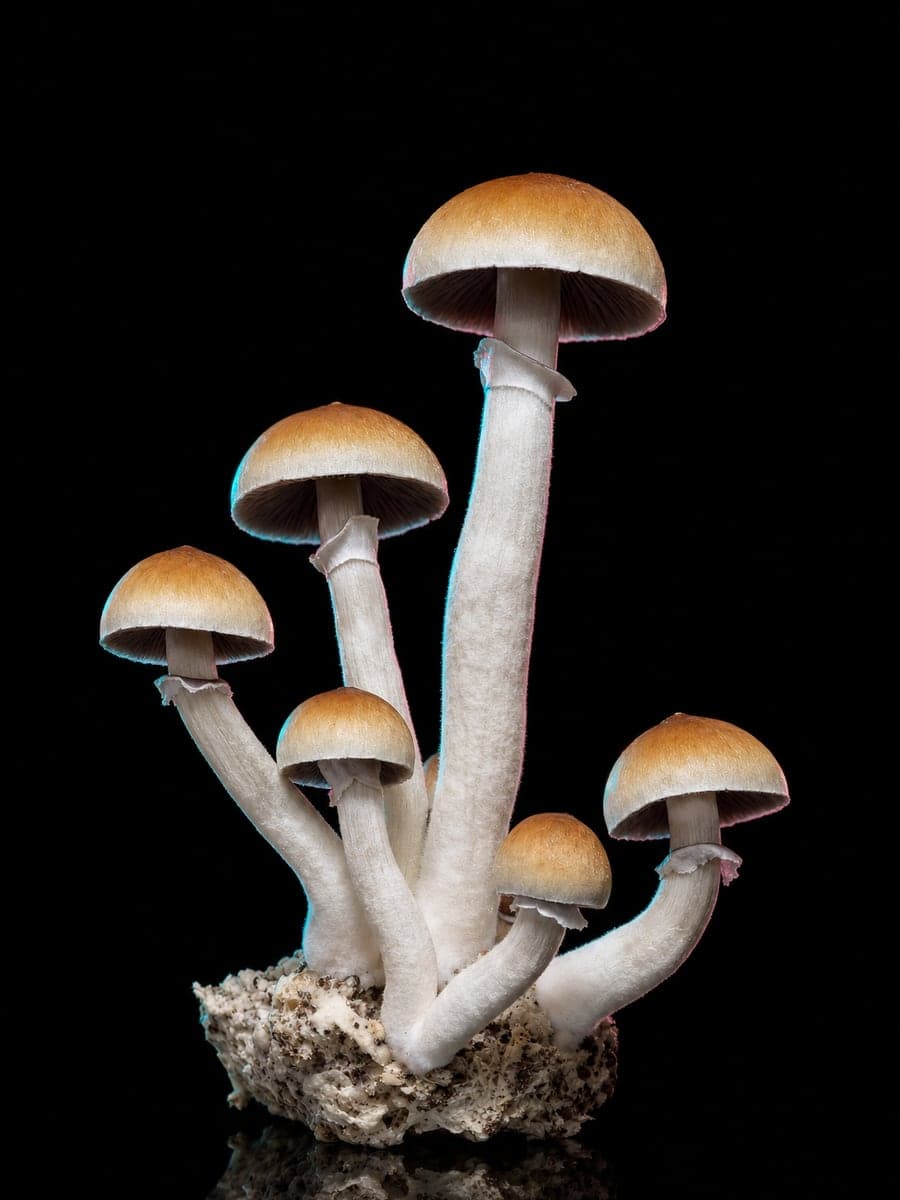
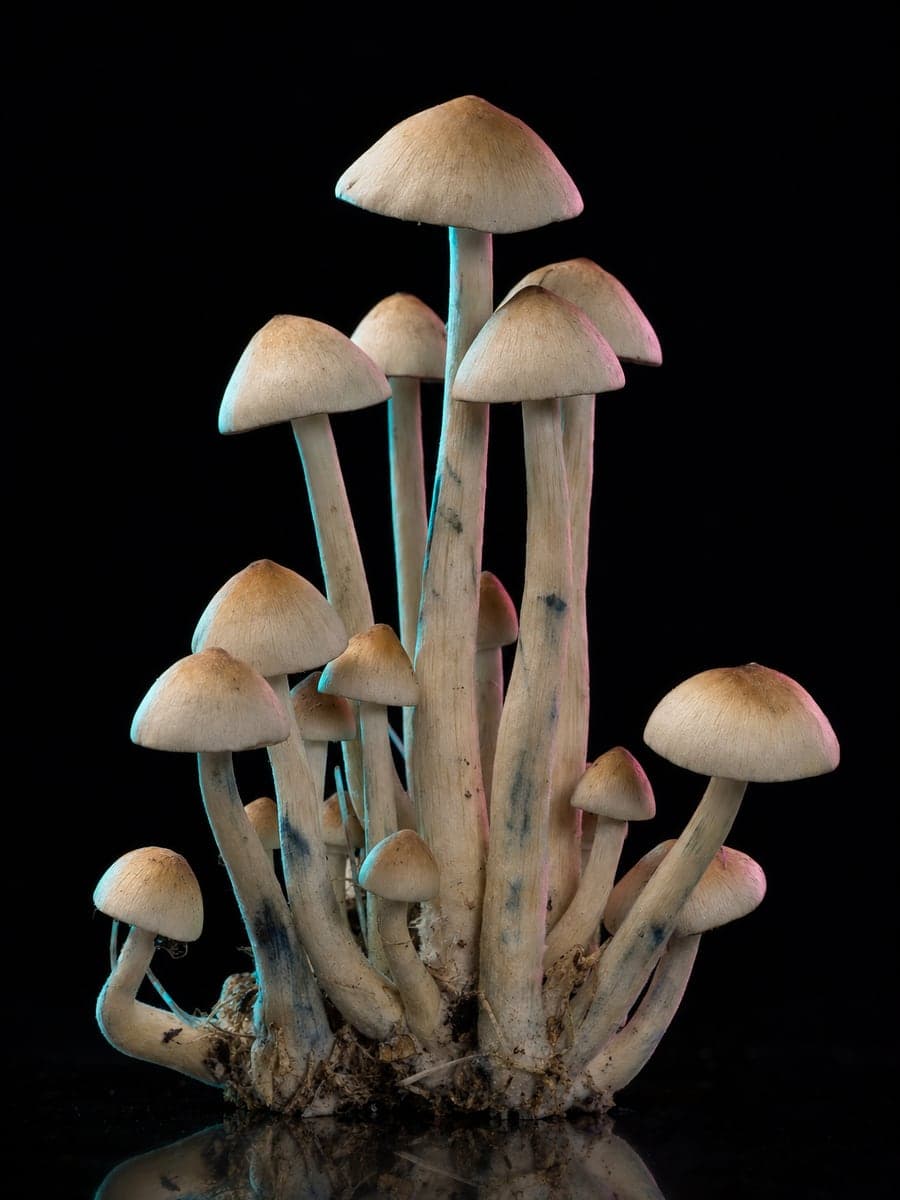
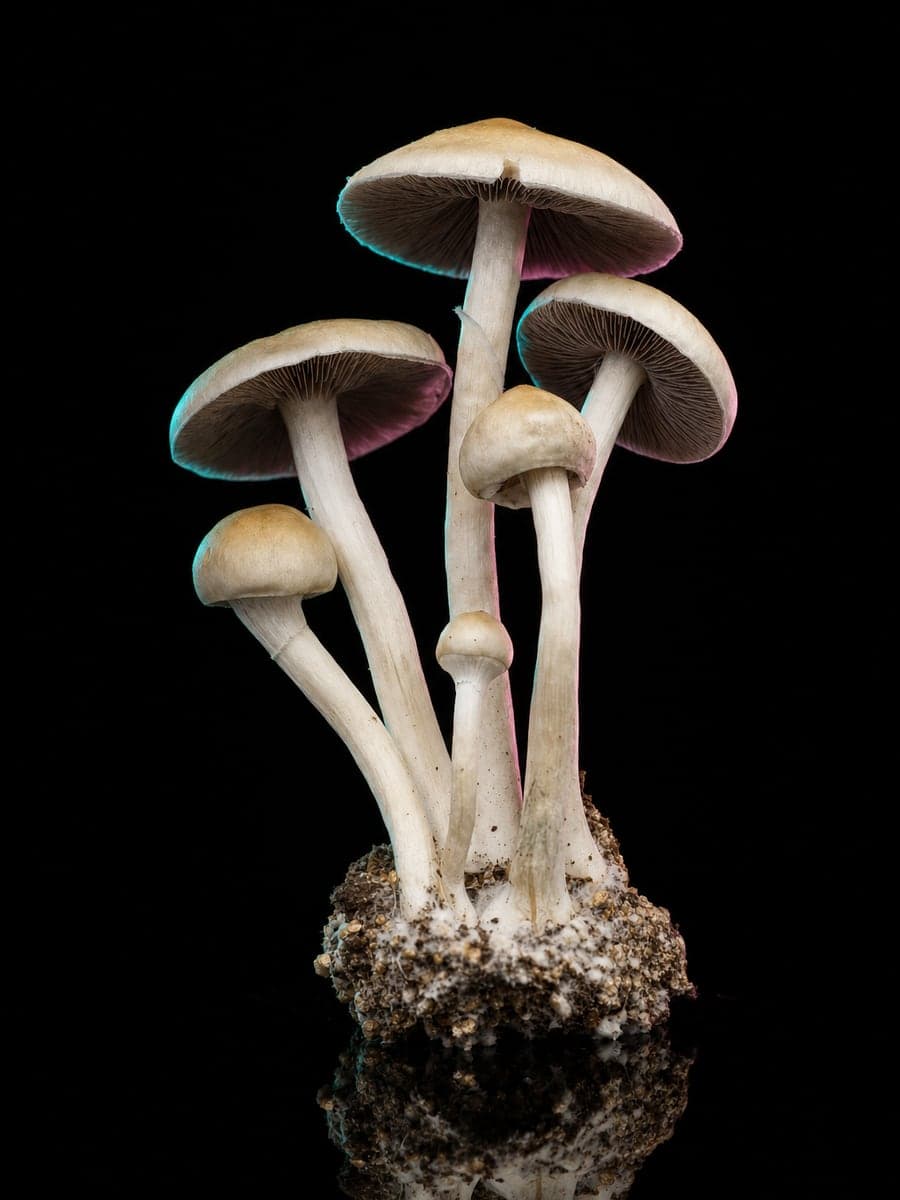
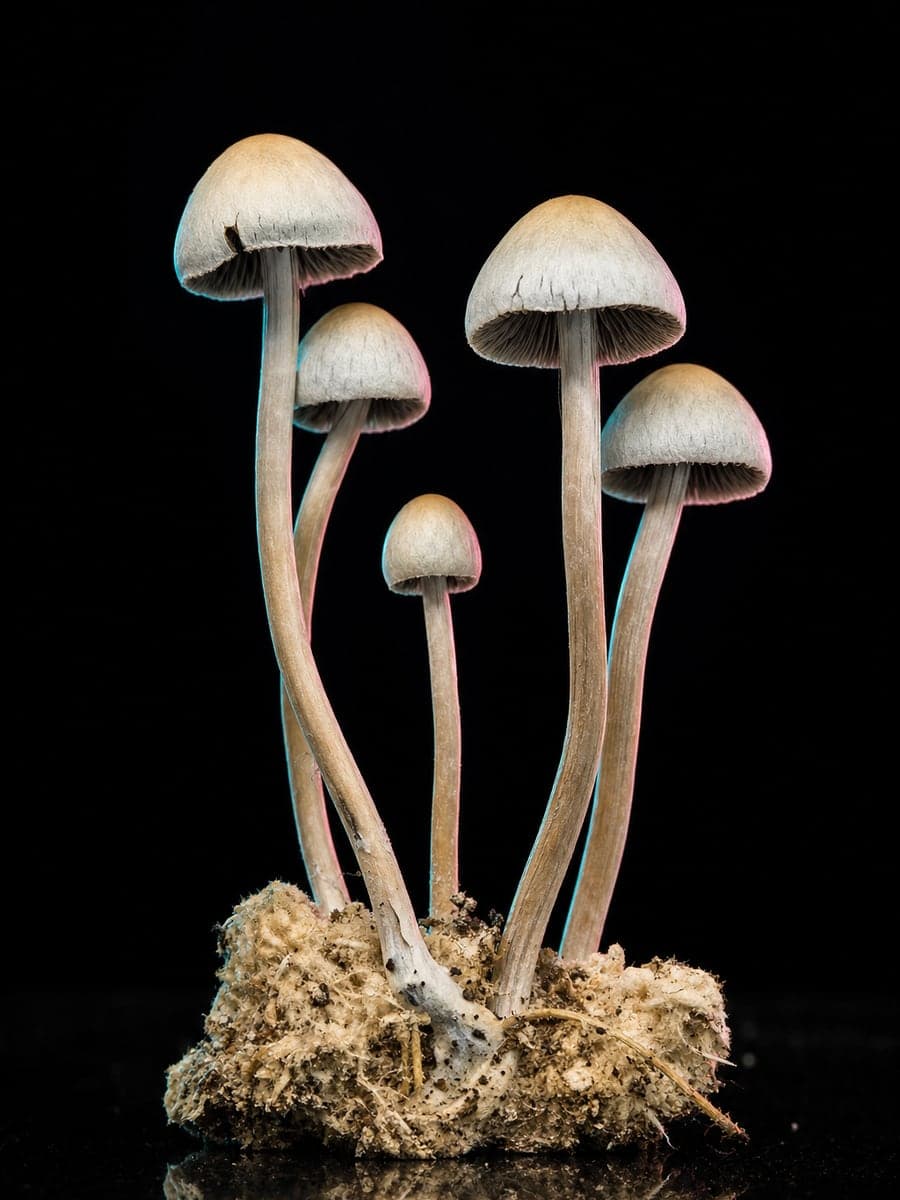
- Small, about 1–2 cm, conical to bell-shaped, often with a slight point; ochre to brown or straw-coloured, finely lined at the edge, sometimes with blue or green tints.
- Stems
- Long and thin, 4–10 cm by 1–2 mm, hollow, straw to reddish-brown, darker where handled; no ring.
- Notes
- Turns blue where damaged. Gills grey to purple-brown with pale edges; spore print dark purple-brown. Can form sclerotia, dense underground nodules.
- Growing
- Grown in the laboratory since the 1950s; today mostly cultivated for its sclerotia, which contain less than the mushrooms themselves.
How it is described
Psilocybe mexicana is known less through modern trip reports than through history, above all Hofmann's own account of vivid inner pictures. Lab figures put it somewhat below a typical cubensis.
Based on: Lab data (Gotvaldová et al. 2022) for potency; Hofmann's published self-experiment for reputation. No trip-report consensus.
Psilocybe mexicana, asked and answered
Where does Psilocybe mexicana come from?
Mexico and Central America, where it grows in grassy meadows and pastures near deciduous woodland, fruiting from May to October.
What does Psilocybe mexicana look like?
A small, slender mushroom with a bell-shaped ochre to brown cap about 1 to 2 cm across, often with a slight point, on a long, thin reddish-brown stem.
Is Psilocybe mexicana strong?
Lab tests put it below a typical cubensis: a 2022 study measured roughly 0.3 to 0.4% psilocybin plus about 0.2% psilocin. Strength varies.
Why is Psilocybe mexicana famous?
Albert Hofmann's team first isolated psilocybin from it in 1958, using mushrooms grown in the lab.
Can I pick Psilocybe mexicana in the wild?
It is a wild mushroom, and many small brown grassland mushrooms, some of them deadly, look alike. Never pick a wild mushroom to eat from a picture; only an expert identification can tell them apart.
The Shroomdex records history and reputation, not advice: how a strain is described is never a promise of how it will feel, and nothing here is medical advice. Strength varies from batch to batch. Start low and see our dose calculator. Never forage from a website: deadly look-alikes grow wild.