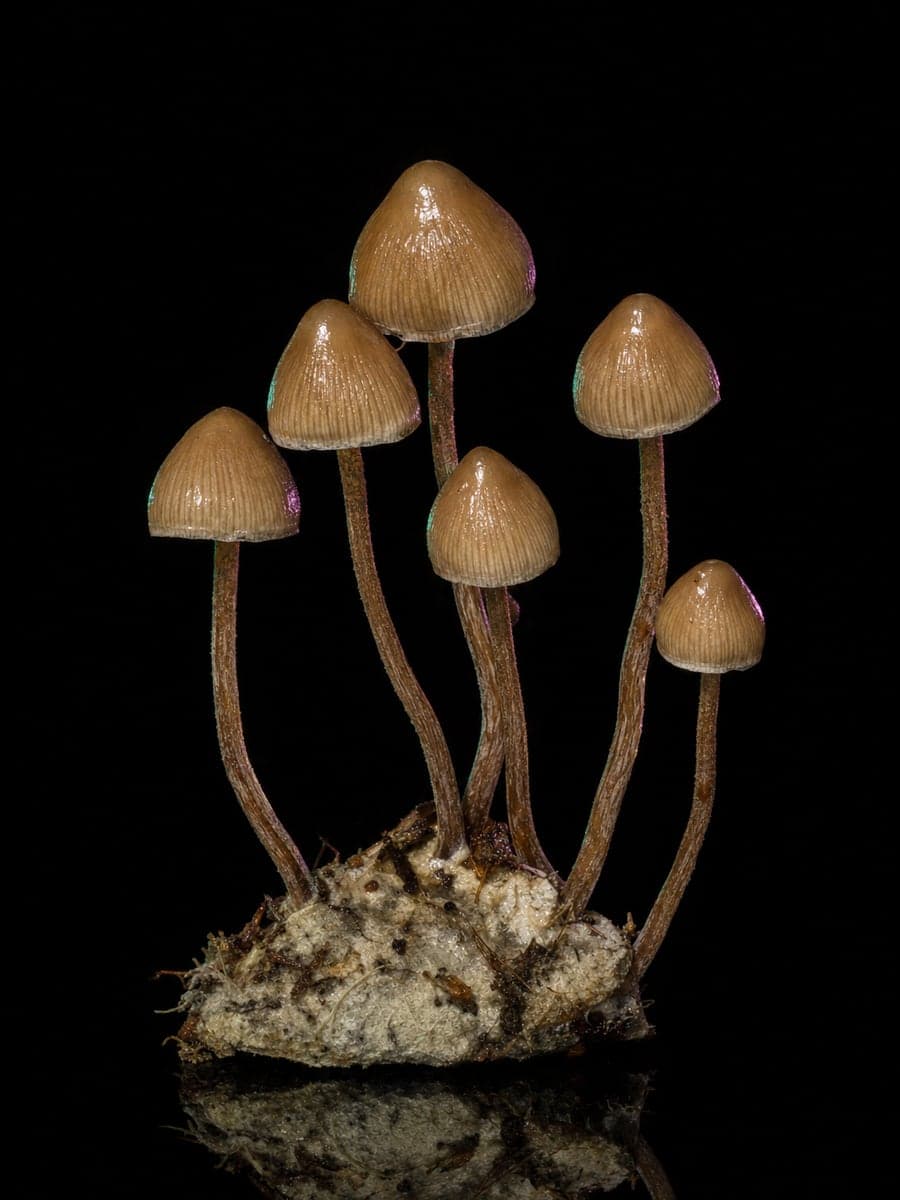
Psilocybe pelliculosa
A small, sticky-capped Psilocybe of conifer woods.
Alexander H. Smith described it in 1937 as Psathyra pelliculosa from Washington and Oregon specimens, the type collected near Tahkenitch Lake, Oregon, in November 1935. Rolf Singer and Smith moved it to Psilocybe in 1958.
It shares the common name 'liberty cap' with P. semilanceata in some field guides.
Where Psilocybe pelliculosa comes from
Psilocybe pelliculosa, the conifer Psilocybe, is a small brown mushroom of conifer forests in the Pacific Northwest, including much of British Columbia. Its name refers to the thin gelatinous film on its cap, which can be peeled away. It is weak compared with most psilocybin mushrooms, and it is a wild mushroom with deadly look-alikes.
- Origin
- Pacific Northwest of North America: British Columbia, Washington, Oregon, Idaho and California; one reported collection from Finland. Type collected near Tahkenitch Lake, Oregon · Described by Alexander H. Smith in 1937
- Family
- Other species · Americas · Uncommon
- Lineage
- A species, not a cultivated strain. Very close to P. silvatica and easily confused with P. semilanceata.
Alexander H. Smith described it in 1937 as Psathyra pelliculosa from Washington and Oregon specimens, the type collected near Tahkenitch Lake, Oregon, in November 1935. Rolf Singer and Smith moved it to Psilocybe in 1958.
Wikipedia: Psilocybe pelliculosa (pointer to Smith 1937; Singer & Smith 1958)Its name comes from the Latin pellicula, a film, for the gelatinous layer on the cap that can be peeled away.
Wikipedia: Psilocybe pelliculosa (pointer)It grows in groups or clusters on moss, forest debris and humus in conifer forests, favouring disturbed ground such as trails and old forest roads, from late summer to early winter after cool, wet weather. It is found widely in British Columbia and south to California.
Wikipedia: Psilocybe pelliculosa (pointer)Analyses found psilocybin at 1.2–1.7 mg/g of dried mushroom (Beug and Bigwood, 1982) and a little baeocystin; Paul Stamets considers its potency relatively weak.
Wikipedia: Psilocybe pelliculosa (pointer to Beug & Bigwood 1982; Repke et al. 1977; Stamets)It is hard to tell from P. semilanceata in the field and from P. silvatica without a microscope, and its general look recalls Mycena, Galerina and Hypholoma.
Wikipedia: Psilocybe pelliculosa (pointer)Wikipedia: Psilocybe semilanceata (pointer to Guzmán et al. 1976)
It shares the common name 'liberty cap' with P. semilanceata in some field guides.
What it looks like
- Caps
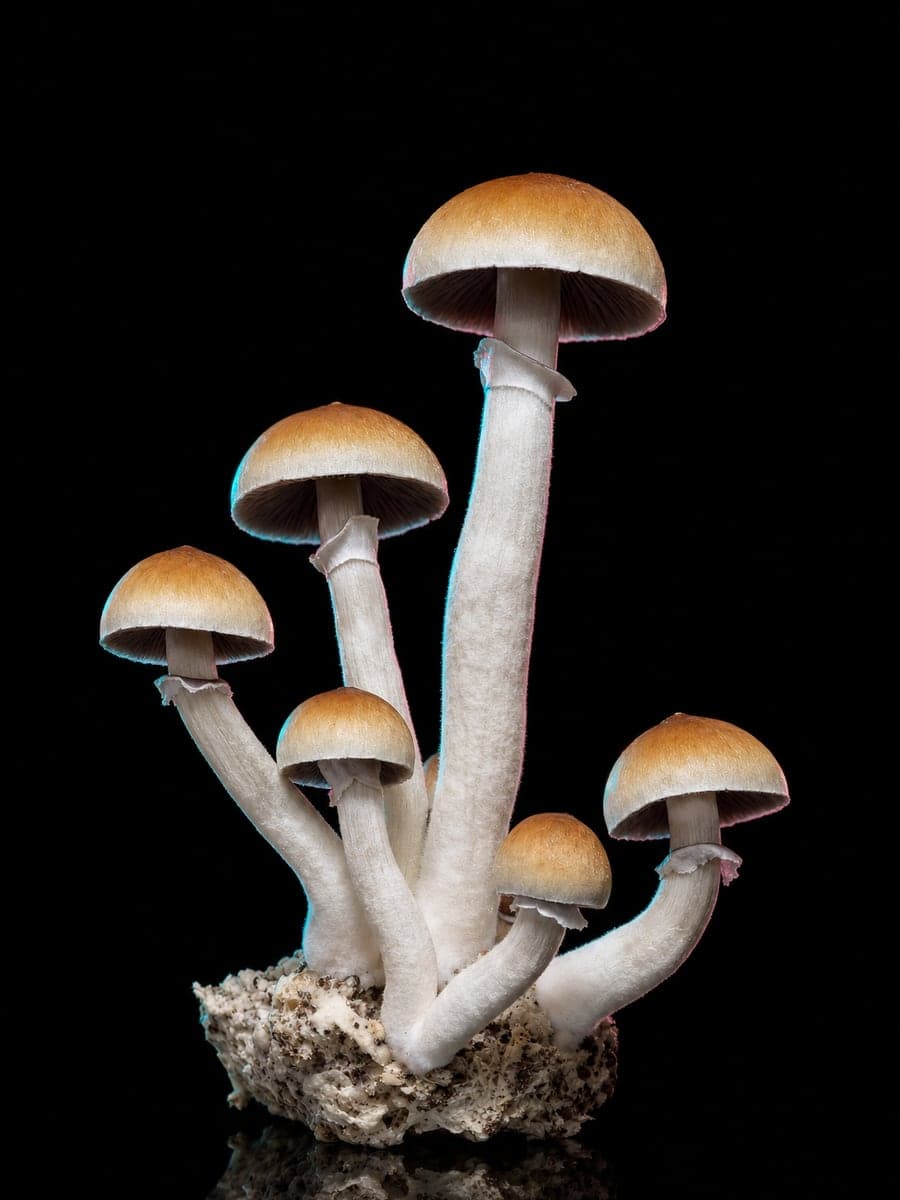
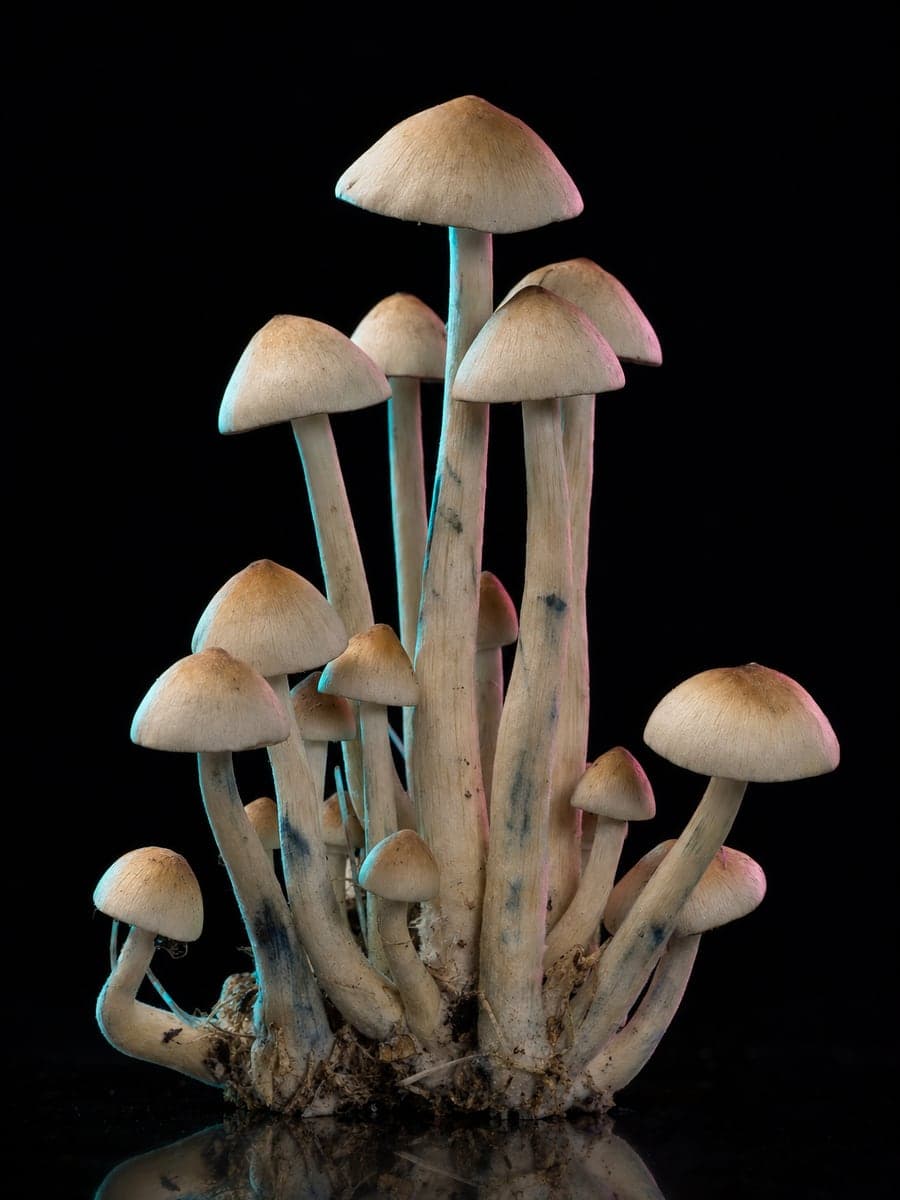
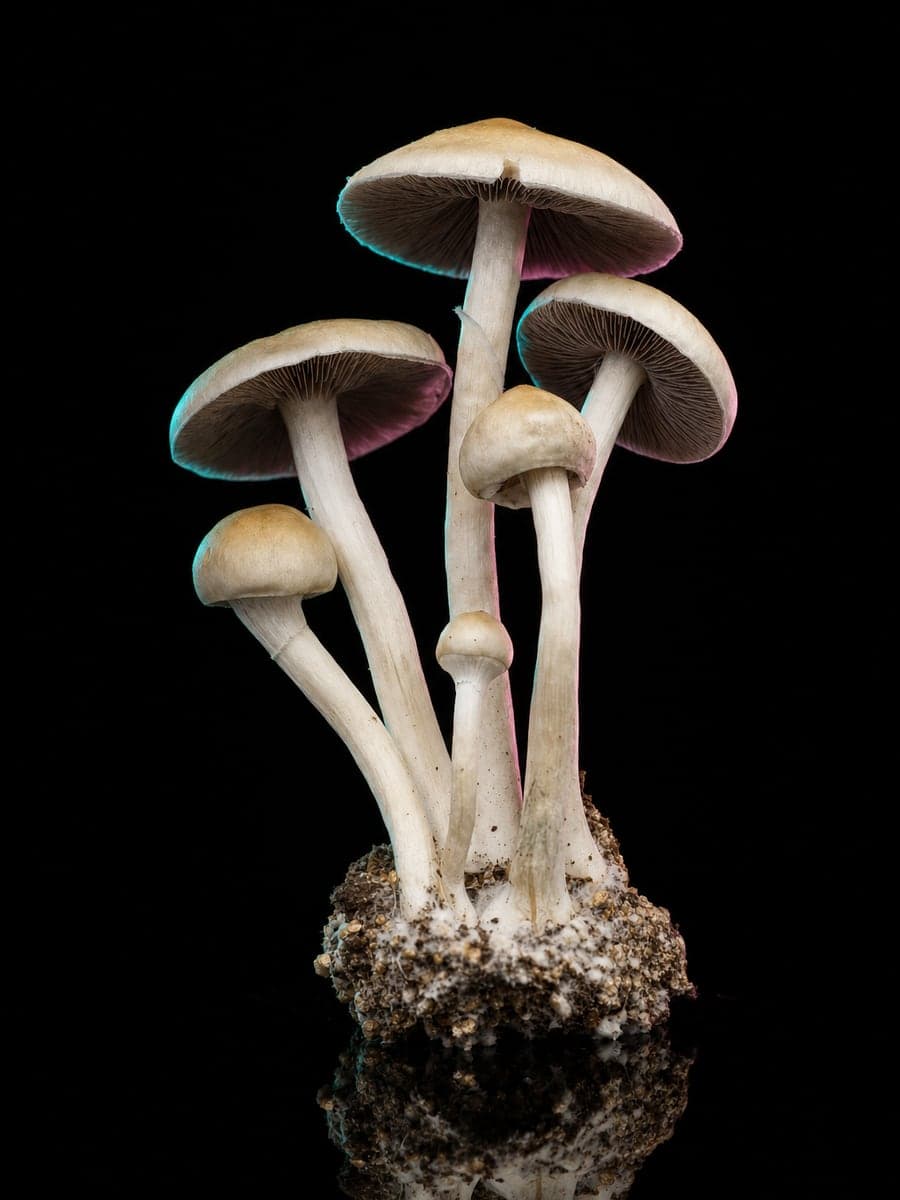
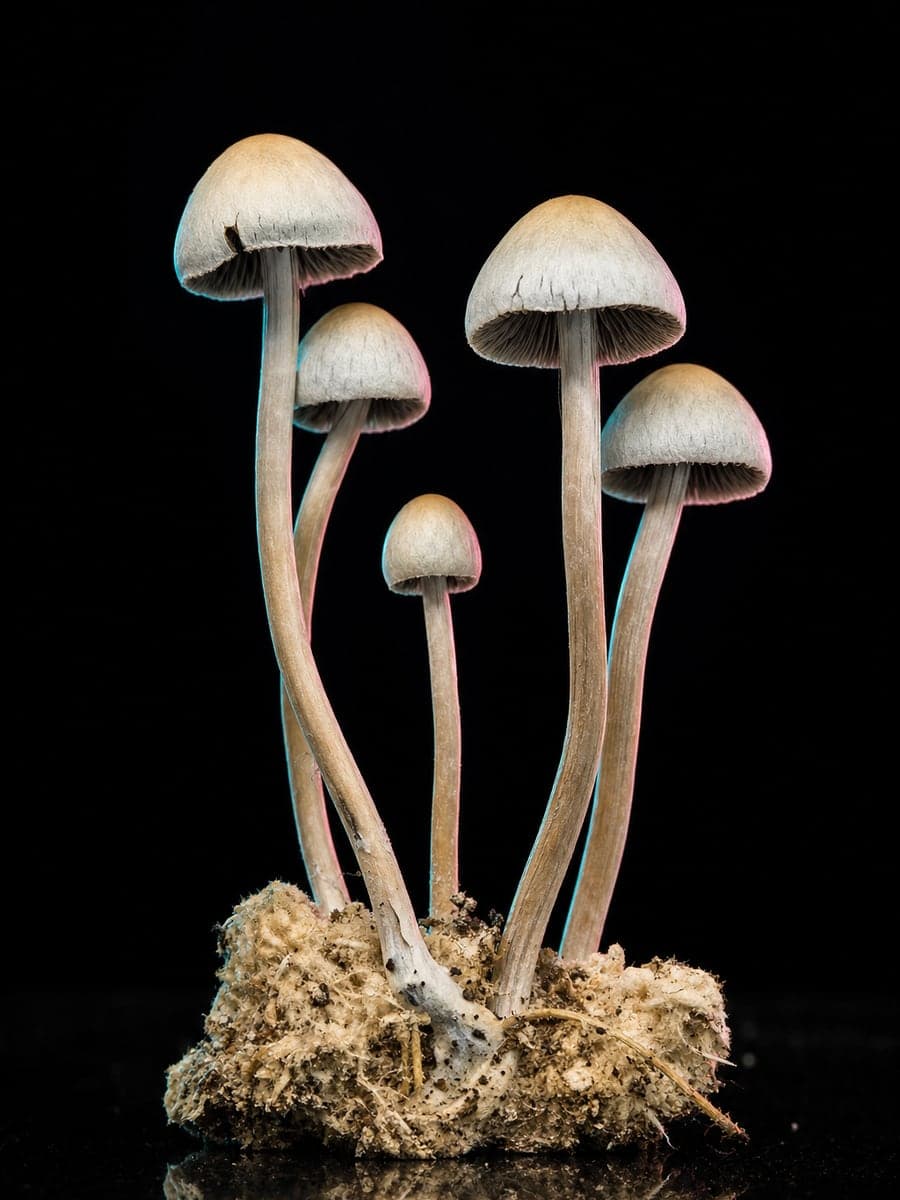
- Up to 2 cm across, conical then broadly bell-shaped; sticky, with translucent radial lines; umber to pale tan when wet, pinkish-buff when dry. A thin gelatinous skin can be peeled off.
- Stems
- Thin, about 6–8 cm long and 1.5–2 mm thick, brownish and silky-fibrous below, greyish and lightly powdery above.
- Notes
- Gills cinnamon-brown, darkening with the spores; spore print purplish brown. Flesh bruises slightly blue or green. Grows in groups on moss and debris in conifer woods.
- Growing
- Not grown commercially; known as a wild mushroom of conifer forest debris.
How it is described
The conifer Psilocybe has a reputation as a weak mushroom, and published analyses put it well below most cubensis. Little else is reported about it.
Based on: Published analyses (Beug & Bigwood 1982, via Wikipedia) and Stamets' assessment; no trip-report consensus.
Psilocybe pelliculosa, asked and answered
Where does Psilocybe pelliculosa come from?
It is a wild species of the Pacific Northwest, from British Columbia south to California, growing on moss and debris in conifer forests. It was described from Oregon in 1937.
What does Psilocybe pelliculosa look like?
A small, sticky, bell-shaped brown cap up to about 2 cm wide, with a peelable skin and fine lines, on a thin brownish stem.
Is Psilocybe pelliculosa strong?
No. It is one of the weaker psilocybin mushrooms: analyses found about 0.12–0.17% psilocybin.
Can I pick Psilocybe pelliculosa in the wild?
It is a wild mushroom with deadly look-alikes: it resembles many other small brown woodland mushrooms. Never pick a wild mushroom to eat from a picture; only an expert identification can tell them apart.
The Shroomdex records history and reputation, not advice: how a strain is described is never a promise of how it will feel, and nothing here is medical advice. Strength varies from batch to batch. Start low and see our dose calculator. Never forage from a website: deadly look-alikes grow wild.