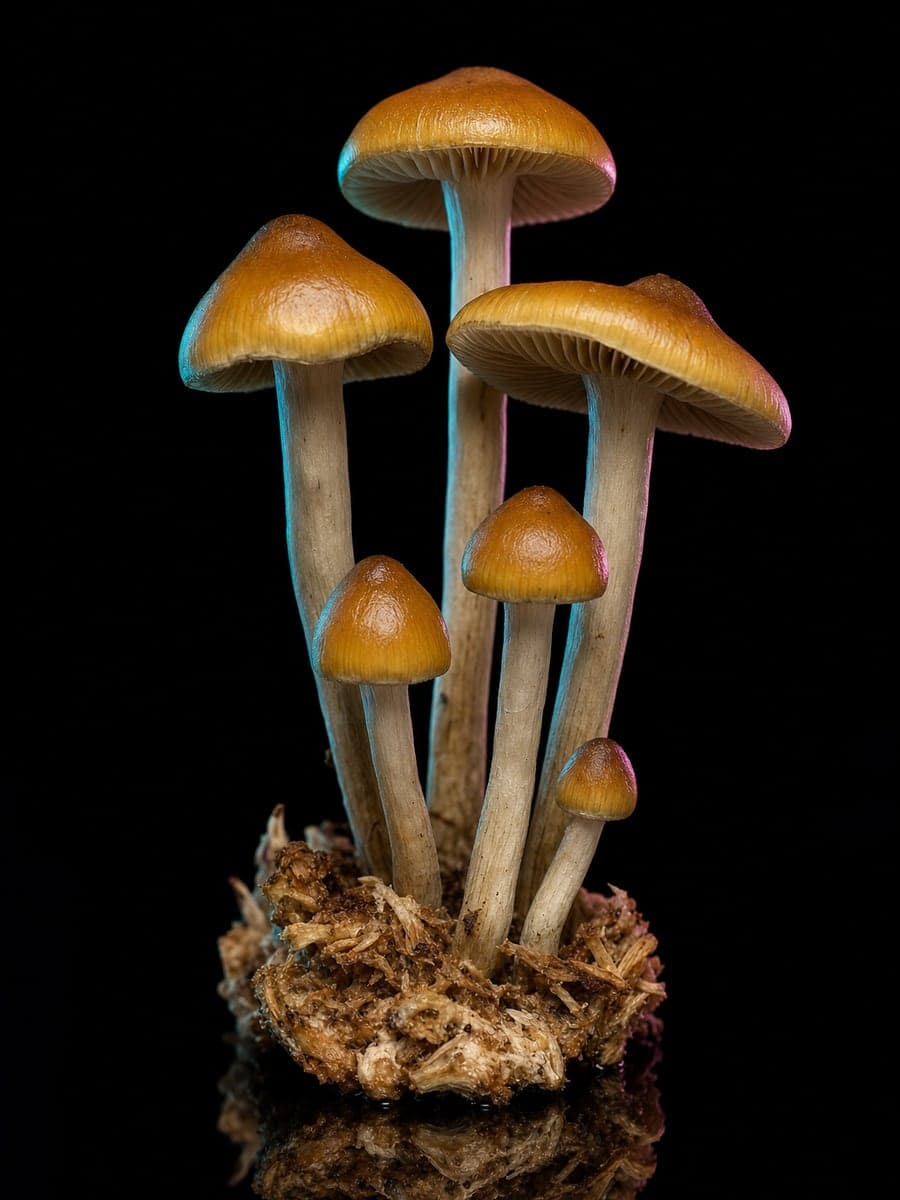
Psilocybe subaeruginosa
Australia's woodlover, and perhaps the group's ancestor.
John Burton Cleland described it from Australia in 1927; the name refers to the copper-rust, blue-green colour of its bruising.
Australian pickers call them 'subs' and talk of autumn and winter forays into pine plantations and eucalypt forest.
Where Psilocybe subaeruginosa comes from
Psilocybe subaeruginosa is a wood-loving psilocybin mushroom of southern Australia, described in 1927 and also recorded in New Zealand. A 2024 study of 89 genomes suggests Australasia is the home of the whole woodlover group, and that northern relatives such as P. cyanescens and P. azurescens spread from there. It is a wild mushroom with deadly look-alikes.
- Origin
- Southern and eastern Australia, from south-east Queensland to Tasmania, South Australia and Western Australia; also recorded in New Zealand · Described 1927
- Family
- Other species · Oceania · Uncommon
- Lineage
- A species, not a cultivated strain. It has naming priority in a complex that may include P. australiana, P. eucalypta, P. allenii, P. azurescens and P. cyanescens.
John Burton Cleland described it from Australia in 1927; the name refers to the copper-rust, blue-green colour of its bruising.
McTaggart et al. (2024), Fungal Systematics and Evolution 14Wikipedia: Psilocybe subaeruginosa (pointer)A 1992 study proposed merging P. australiana, P. eucalypta and P. tasmaniana into P. subaeruginosa; Guzmán objected, but the merger was accepted in 1995 for all but P. tasmaniana.
Wikipedia: Psilocybe subaeruginosa (pointer to Chang & Mills 1992; Johnston & Buchanan 1995)Guzmán, Allen & Gartz (1998/2000), Ann. Mus. civ. Rovereto 14 (cites Chang & Mills 1992; Johnston & Buchanan 1995)A 2024 study of 89 genomes found northern-hemisphere woodlovers nested among Australian P. subaeruginosa populations, still fully able to mate with them, and concluded Australasia is their centre of origin, with woodchips, mulch or plants carrying them abroad.
McTaggart et al. (2024), 'Wood-loving magic mushrooms from Australia are saprotrophic invaders in the Northern Hemisphere', Fungal Systematics and Evolution 14Lab figures disagree. A 1970 analysis isolated psilocybin at 0.45%, while a 2022 study found very low tryptamines in its Australian samples (at most 0.33 mg/g psilocin) and suggested the species may produce much more under other conditions.
Gotvaldová et al. (2022), Int. J. Mol. Sci. 23: 14068Wikipedia: Psilocybe subaeruginosa (pointer to Picker & Rickards 1970)It is hunted keenly in Australia and resembles several toxic mushrooms, including the deadly Galerina marginata, Cortinarius and Hypholoma species, and Leratiomyces ceres on wood chips.
Wikipedia: Psilocybe subaeruginosa (pointer)
Australian pickers call them 'subs' and talk of autumn and winter forays into pine plantations and eucalypt forest.
It is often named, with its northern relatives, in talk of wood lover's paralysis.
What it looks like
- Caps
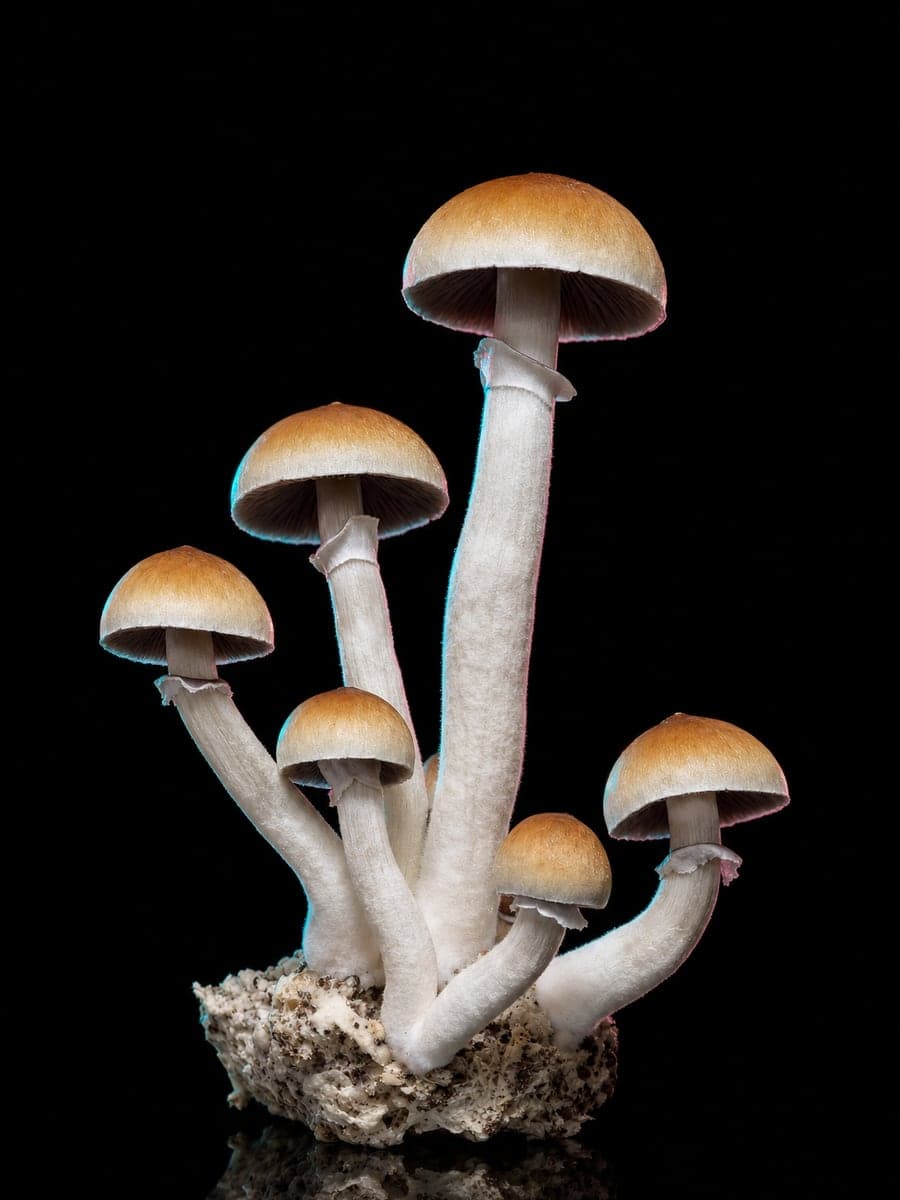
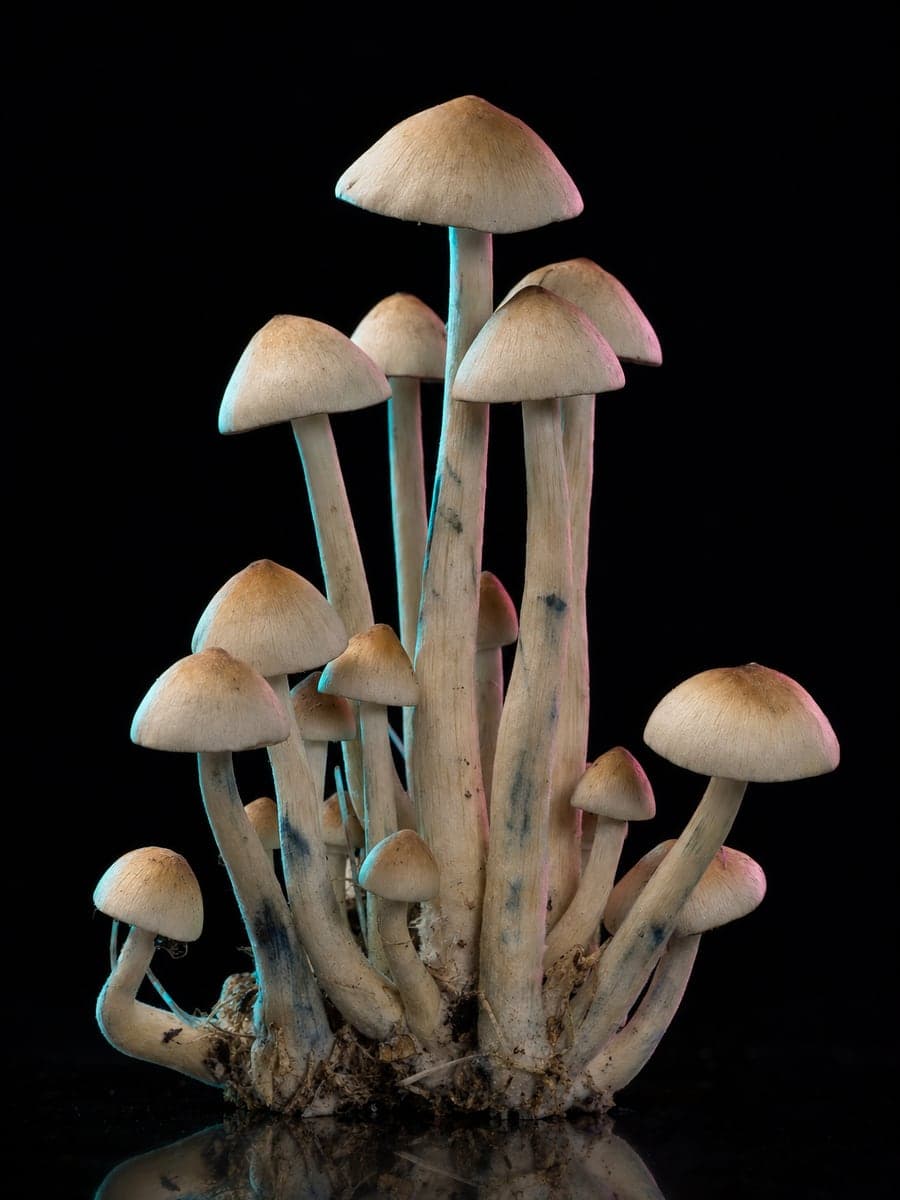
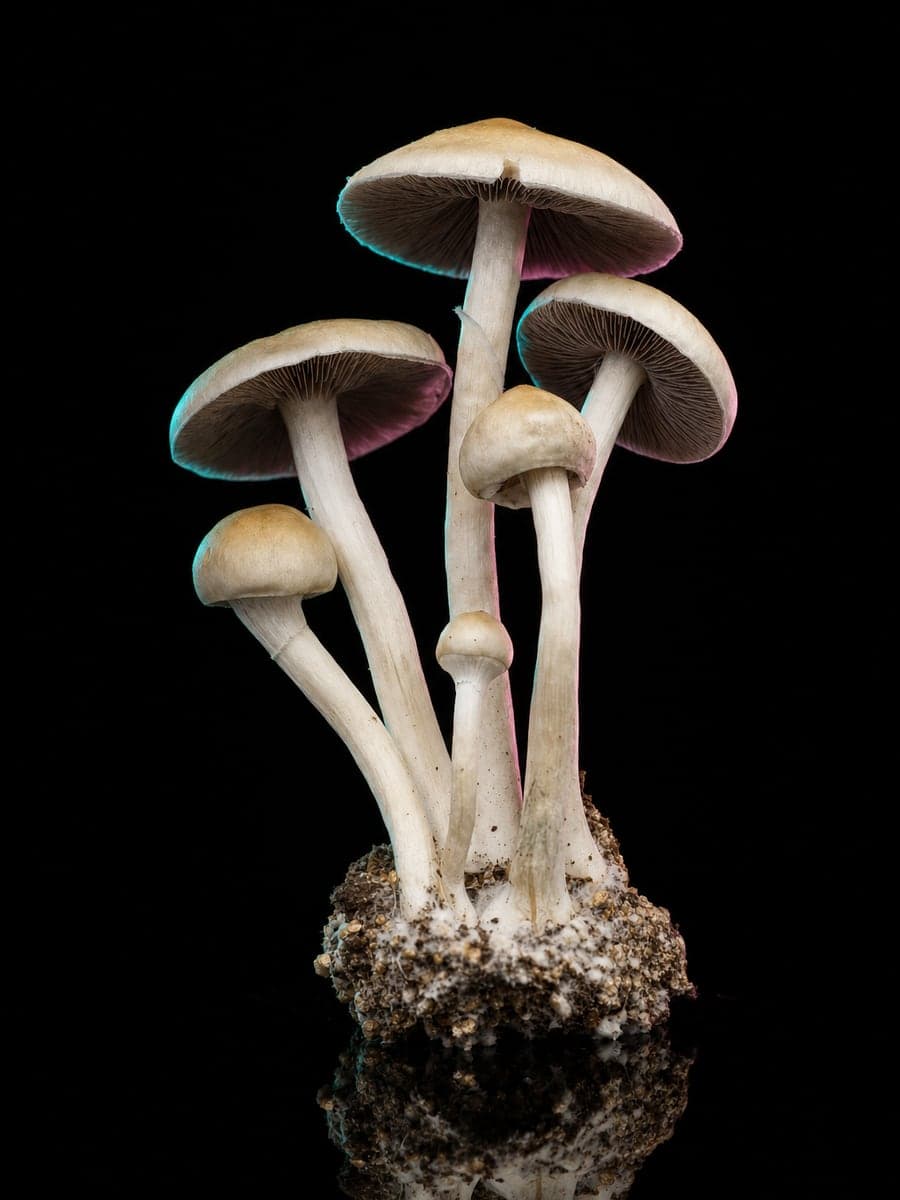
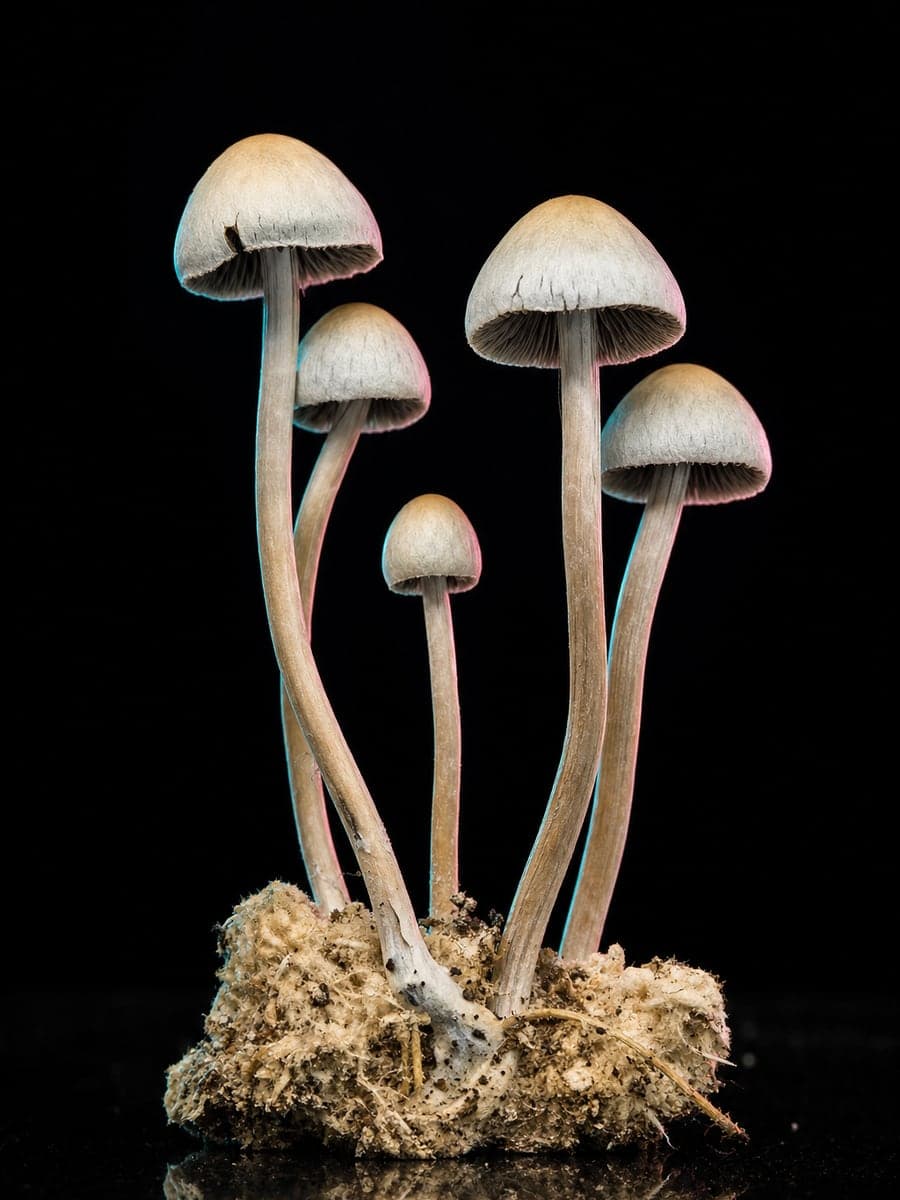
- 1.2–5 cm, conical to convex then flattening, sometimes with a small knob; yellow-brown to orange-brown, paler at the edge, drying to pale biscuit brown and staining blue-green.
- Stems
- Tall and slender, 2.5–7 cm, whitish streaked greyish-brown, hollow, the base swollen or matted with mycelium.
- Notes
- The name refers to the verdigris, blue-green colour of its bruising. A white cobwebby veil soon disappears. Spore print purple-brown. Very variable in shape: conical, papillate or wavy forms all occur.
How it is described
Psilocybe subaeruginosa has a reputation in Australia as a strong woodlover, in line with its close northern relatives. Published lab figures are mixed, from modest to very low, so its real strength is uncertain.
Based on: Regional reputation and its close relationship to potent woodlovers; lab figures conflict (Gotvaldová et al. 2022; Picker & Rickards 1970 via Wikipedia).
Psilocybe subaeruginosa, asked and answered
Where does Psilocybe subaeruginosa come from?
Southern and eastern Australia, from Queensland to Tasmania and Western Australia, where it grows on wood debris in native forest and pine plantations from autumn into winter. It is also recorded in New Zealand.
What does Psilocybe subaeruginosa look like?
Orange-brown to yellow-brown caps, paler at the edge and sometimes knobbed, on tall, slender whitish stems. It stains blue-green where handled.
Is Psilocybe subaeruginosa strong?
It has a strong reputation in Australia, but the lab figures disagree: one 1970 analysis found 0.45% psilocybin, while a 2022 study found very little in its samples.
Is it related to Psilocybe cyanescens and azurescens?
Closely. A 2024 genome study places those northern woodlovers among Australian P. subaeruginosa populations and suggests they spread from Australasia.
Can I pick Psilocybe subaeruginosa in the wild?
It is a wild mushroom, and Australian forests hold deadly look-alikes such as Galerina marginata. Never pick a wild mushroom to eat from a picture; only an expert identification, with a spore print, can tell them apart.
The Shroomdex records history and reputation, not advice: how a strain is described is never a promise of how it will feel, and nothing here is medical advice. Strength varies from batch to batch. Start low and see our dose calculator. Never forage from a website: deadly look-alikes grow wild.