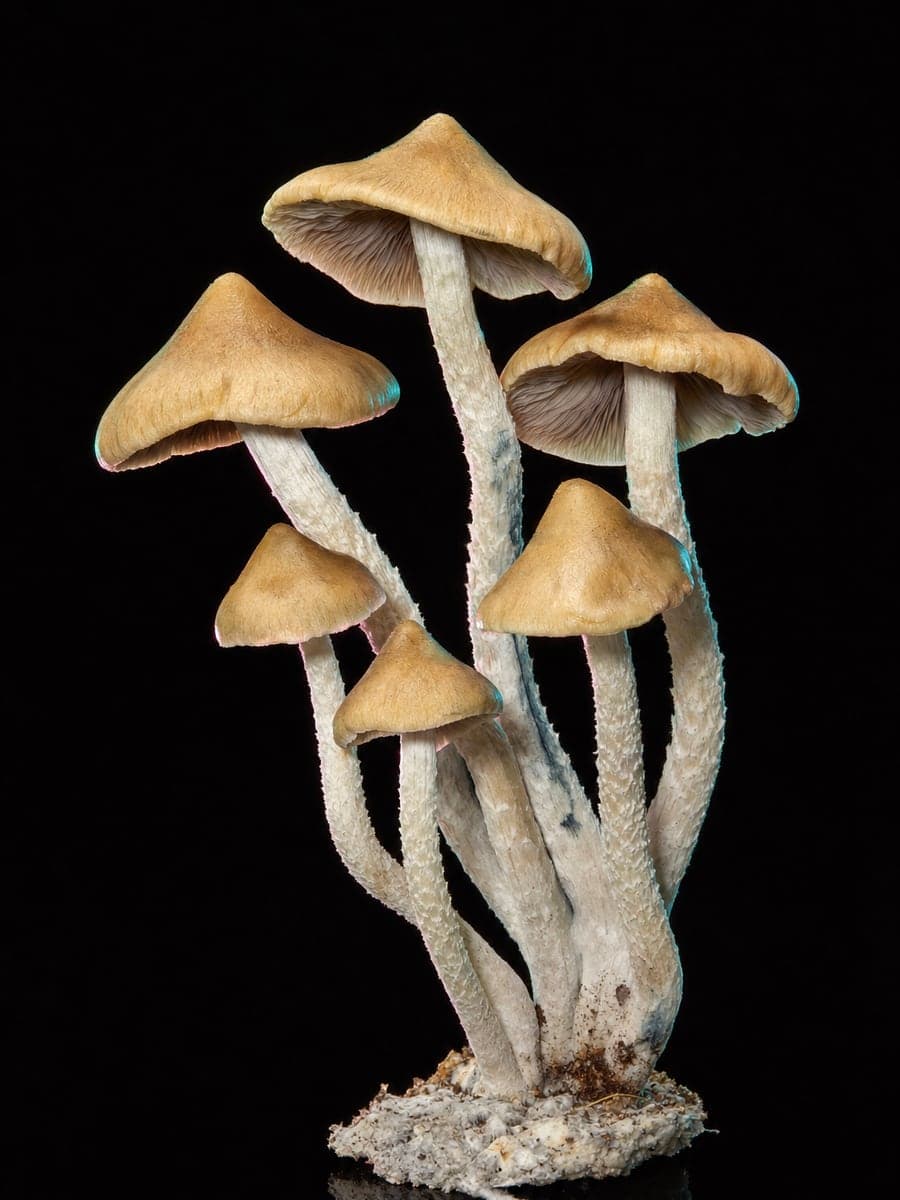
Psilocybe zapotecorum
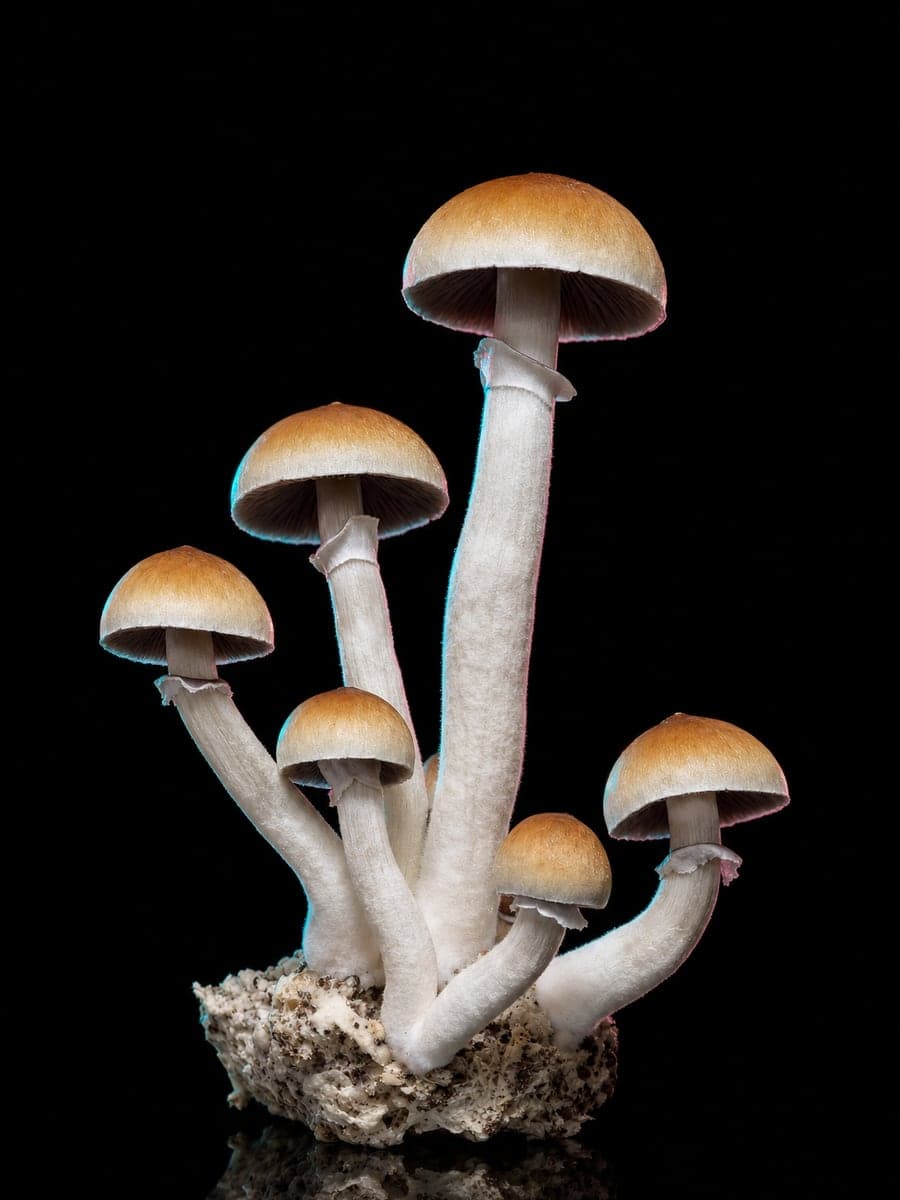
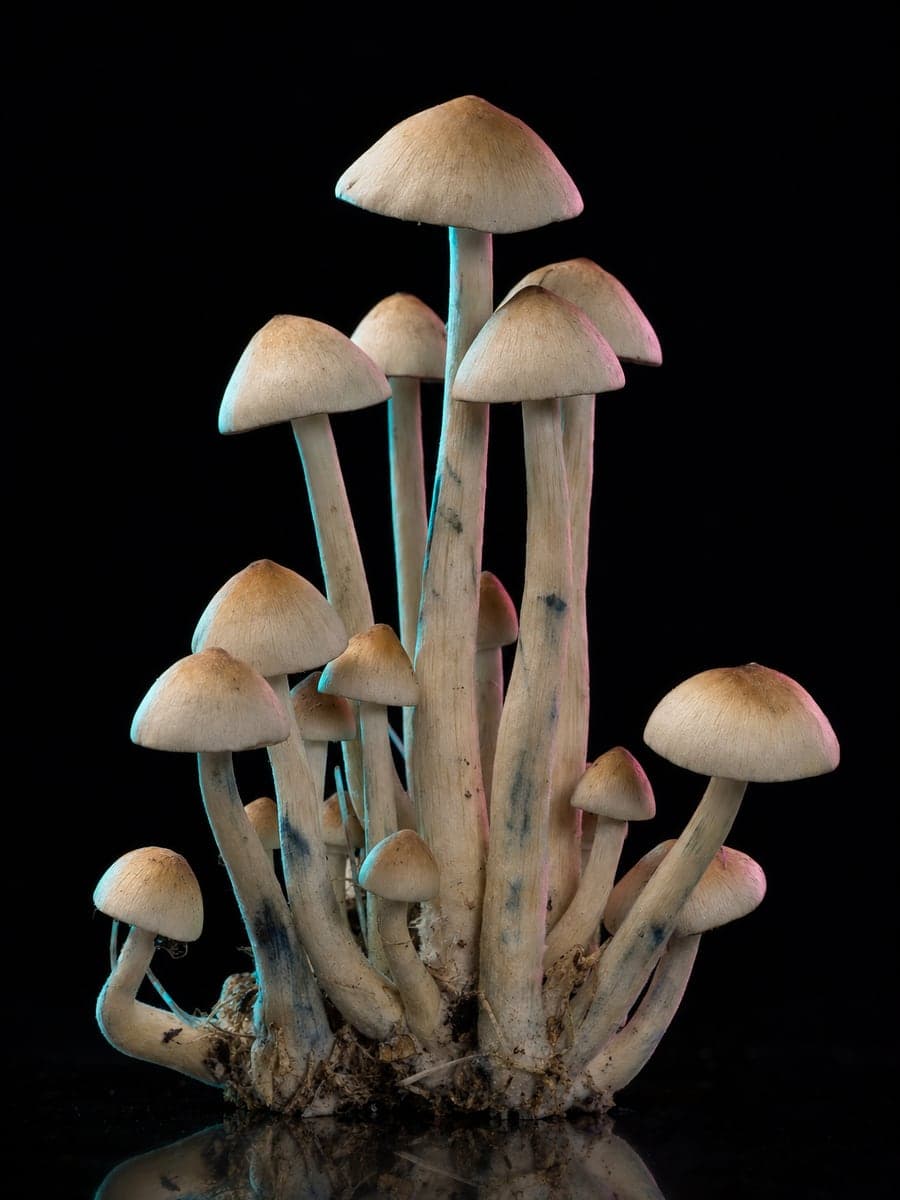
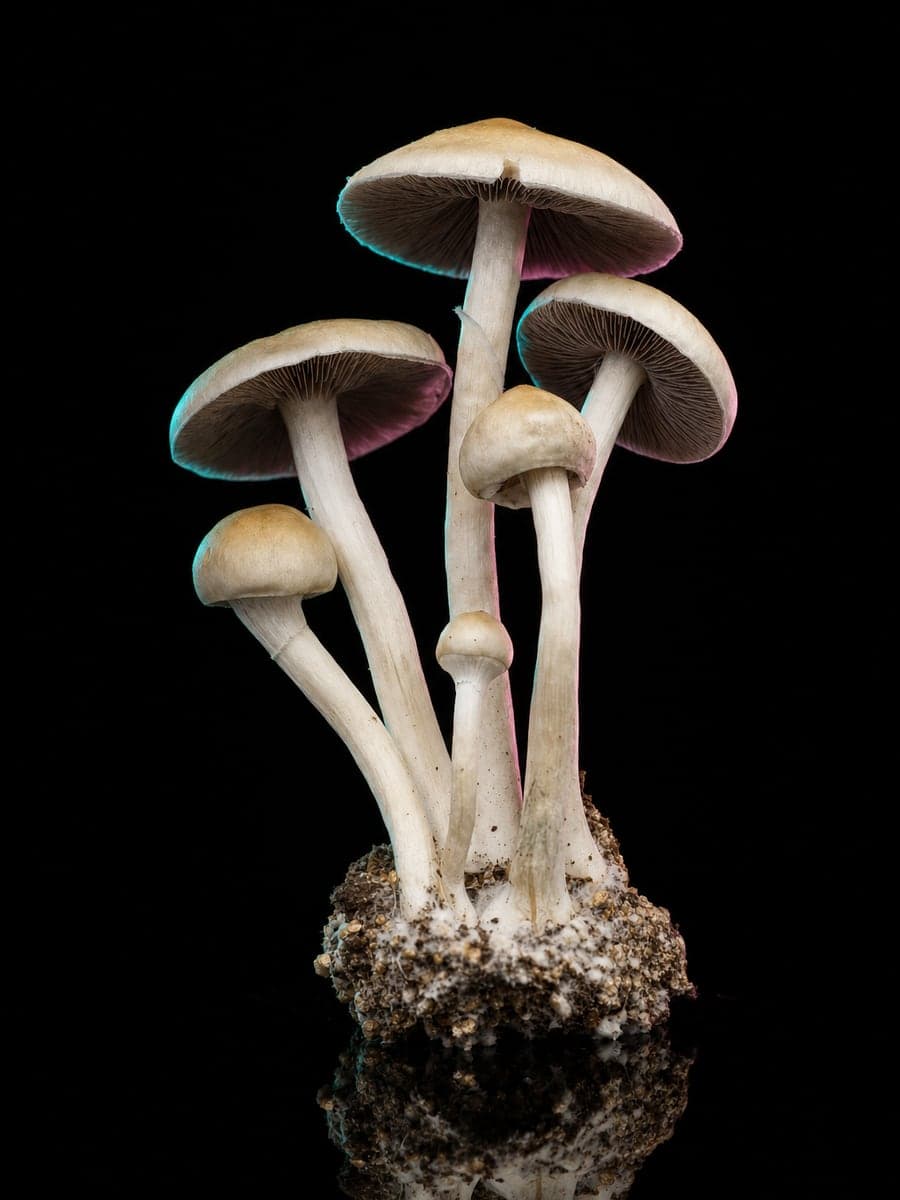
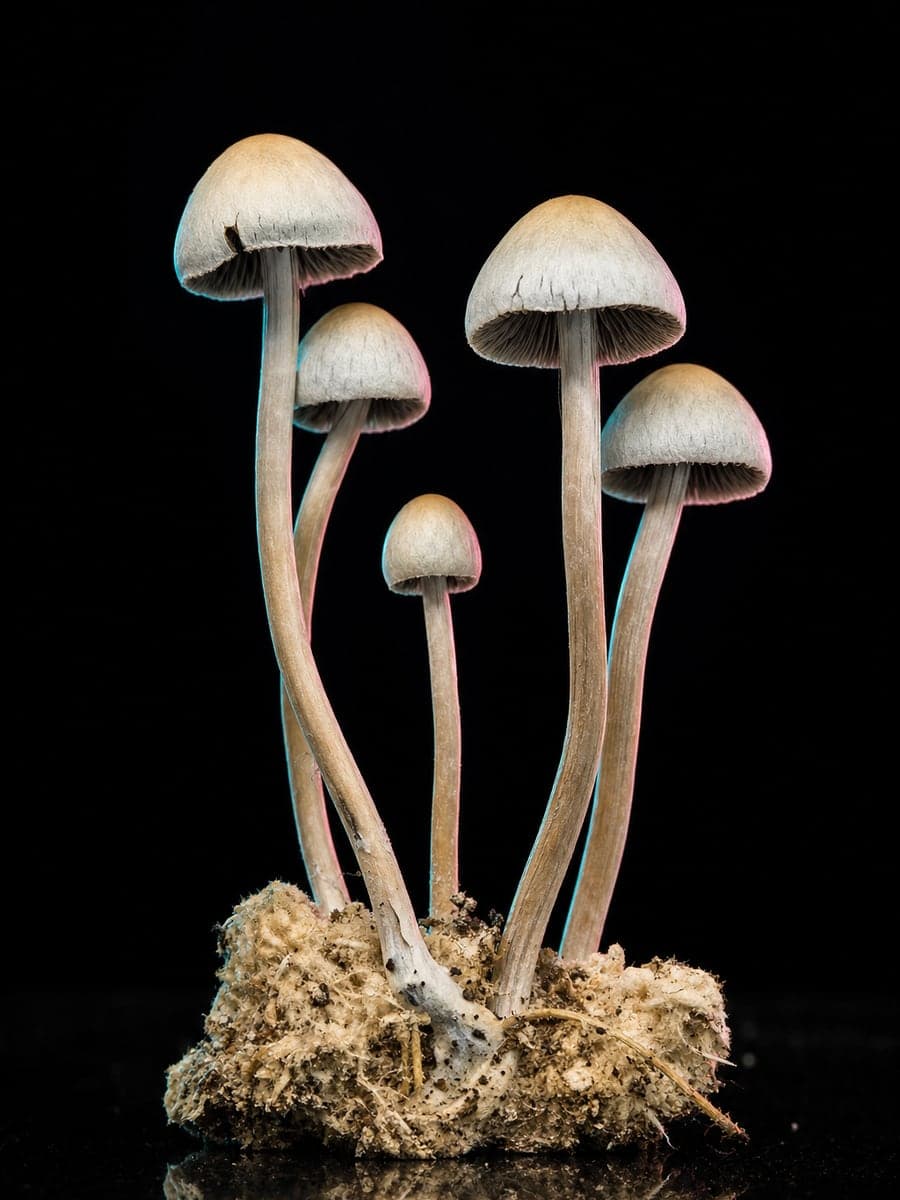
A clustered ravine mushroom with scaly white stems.
Miller and colleagues (2024) cultivated it, confirmed its identity by DNA barcoding and sequenced its full genome, including the psilocybin gene cluster. Seven samples averaged 17.9 mg/g psilocybin (range 10.6–25.7) and 22.5 mg/g total tryptamines.
Richard Evans Schultes gave its Zapotec name as 'crown of thorns mushroom'; other sources give badao zoo, 'drunken mushroom'.
Where Psilocybe zapotecorum comes from
Psilocybe zapotecorum is a large, strongly blue-bruising psilocybin mushroom of Mexico and South America, named after the Zapotec people of Oaxaca and used in ceremonies there. Roger Heim and R. Gordon Wasson collected the holotype in 1956. A 2024 study that grew, analysed and sequenced it found it potent and very variable, and it is a wild mushroom with deadly look-alikes.
- Origin
- Mexico (type from Santiago Yaitepec, Oaxaca) south through Central America to Colombia, Ecuador, Peru, Brazil, Argentina and Chile; humid ravines and stream banks · Holotype collected 1956; described by Heim, 1957–58
- Family
- Other species · Americas · Rare
- Lineage
- A species, the namesake of section Zapotecorum; Guzmán links it to New Zealand's P. aucklandii in the same section.
Miller and colleagues (2024) cultivated it, confirmed its identity by DNA barcoding and sequenced its full genome, including the psilocybin gene cluster. Seven samples averaged 17.9 mg/g psilocybin (range 10.6–25.7) and 22.5 mg/g total tryptamines.
Miller et al. (2024), Journal of Psychedelic Studies 8(1): 63–81 (PubMed)Miller et al., preprint (bioRxiv 2023) on PMCA 2022 study of DNA-confirmed collections, which its authors describe as the first analytical data for the species, measured 9.0–9.7 mg/g psilocybin and 0.3–0.4 mg/g psilocin.
Gotvaldová et al. (2022), Int. J. Mol. Sci. 23: 14068Roger Heim and R. Gordon Wasson collected the holotype at Santiago Yaitepec, Oaxaca, on 4 August 1956, and Heim published the first description; Albert Hofmann also found psilocybin in it.
Wikipedia: Psilocybe zapotecorum (pointer)Mushroom Observer: Psilocybe zapotecorum R. Heim, Revue Mycol. 22: 77 (1957)Guzmán's checklist places it in Mexico and South America in section Zapotecorum, and notes that a Psathyrella once confused with it contains no psilocybin, and that Singer's 1958 'P. zapotecorum' is in fact P. hoogshagenii.
Guzmán, Allen & Gartz (1998/2000), Ann. Mus. civ. Rovereto 14: 189–280It grows near rivers, creeks and ravines in humid forests of oak, pine, alder and magnolia, often in clusters, and is used ceremonially by Indigenous groups in south-eastern Mexico.
Miller et al., preprint (bioRxiv 2023) on PMCWikipedia: Psilocybe zapotecorum (pointer)
Richard Evans Schultes gave its Zapotec name as 'crown of thorns mushroom'; other sources give badao zoo, 'drunken mushroom'.
The 1957 Life magazine article that made Wasson's journey famous mislabelled another species, P. hoogshagenii, with this name.
What it looks like
- Caps
- Large for a Psilocybe, 2–13 cm, conical to convex, often knobbed or with a dip in the centre, the edge wavy and scalloped when young; yellowish-brown to tan, fading cream-yellow, then browning and blackening with age.
- Stems
- Long, 3–26 cm by 0.5–1 cm, hollow, white to grey, covered in small white scales, often ending in a long root-like base.
- Notes
- Bruises strongly blue, then black. Grows alone, in groups or in dense clusters of up to about 50, sometimes straight from steep mossy ravine walls. Spore print dark violet-brown.
- Growing
- Miller et al. describe simple, reproducible growing and cloning methods for it; it is still rarely grown compared with cubensis.
How it is described
Psilocybe zapotecorum is described by the researchers who studied it as a potent and chemically variable mushroom. Measured psilocybin averages well above a typical cubensis, but samples differ a great deal.
Based on: Lab analyses (Miller et al. 2024; Gotvaldová et al. 2022). No trip-report consensus used.
Psilocybe zapotecorum, asked and answered
Where does Psilocybe zapotecorum come from?
Mexico, where it was collected in Oaxaca in 1956, and south into Central and South America. It grows in humid ravines and along streams in mountain forests.
What does Psilocybe zapotecorum look like?
Clusters of fairly large mushrooms with tan to yellowish-brown, often wavy-edged caps on long white stems covered in small scales. It bruises blue, then black.
Is Psilocybe zapotecorum strong?
Lab tests suggest so: a 2024 study averaged about 1.8% psilocybin, roughly double a typical cubensis, but samples ranged widely.
Why is it called zapotecorum?
It is named for the Zapotec people of Oaxaca, among whom it is used in ceremonies.
Can I pick Psilocybe zapotecorum in the wild?
It is a wild mushroom, and other clustered brown mushrooms, some of them deadly, grow in the same forests. Never pick a wild mushroom to eat from a picture; only an expert identification can tell them apart.
The Shroomdex records history and reputation, not advice: how a strain is described is never a promise of how it will feel, and nothing here is medical advice. Strength varies from batch to batch. Start low and see our dose calculator. Never forage from a website: deadly look-alikes grow wild.